Let's be honest, managing a sales team isn't just about rah-rah speeches and pipeline reviews. The real work—the stuff that builds a predictable revenue engine—happens long before that. It's about laying a solid foundation by getting three things right: how your team is structured, who you hire, and how you bring them into the fold.
Get this foundation right, and you're not just relying on a few superstars to hit your number. You're building a system where everyone can win.
Building Your Foundation for Sales Success

Before you can coach effectively or forecast accurately, you need to make some architectural decisions. Think of it like building a house—the stronger the foundation, the more stable the structure. A well-designed team makes every other part of your job easier.
The first big choice is deciding on your team structure. There's no single "best" model. The right answer depends entirely on your sales process and where your company is on its growth journey. For a small B2B startup, a couple of generalist Account Executives who handle everything from prospecting to close might be perfect. But as you scale, you'll need to specialize to stay efficient.
Common Sales Team Structures
Most successful B2B teams eventually land on a specialized model. This isn't about creating silos; it's about giving people clear ownership and letting them master a specific part of the sales funnel.
- The Hunter/Farmer Model: This is the classic split for a reason—it works. "Hunters" (your Account Executives) are laser-focused on one thing: landing new logos. Meanwhile, your "Farmers" (Account Managers) are dedicated to nurturing and growing the customers you already have. This separation prevents your team from chasing easy upsells at the expense of new business.
- The Pod Model: A more modern take is to create small, self-contained teams or "pods." A typical pod might have a Sales Development Rep (SDR) finding leads, an Account Executive (AE) closing them, and a Customer Success Manager (CSM) handling everything post-sale. They often work a specific territory or industry together, which creates a fantastic feedback loop and a seamless experience for the customer.
Hiring the Right People for Your System
Once your structure is in place, hiring becomes a whole lot clearer. You're no longer looking for a generic "great salesperson." You're looking for the right person for a very specific seat on the bus.
Your job descriptions need to reflect that. Ditch the vague clichés like "go-getter." Get specific about the skills needed for the role. For an AE, that might be, "Must have proven experience navigating multi-stakeholder deals with an average 6-month sales cycle."
The goal of hiring isn't to find people who can sell, but to find people who can sell your way. A candidate's ability to adapt to your process, culture, and CRM workflows is often more valuable than a flashy resume from a completely different sales environment.
In the interview, go beyond the standard "tell me about a time you closed a big deal." Ask situational questions that test how they think. A personal favorite is, "Walk me through how you would plan your first 90 days to tackle a new, untapped territory." Their answer tells you volumes about their strategic approach, not just their closing stats. For more on building the processes that support your people, our guide on improving customer relationship management is a great resource.
Onboarding for Rapid Productivity
A new hire's first few weeks are make-or-break. A really tight, structured onboarding program can slash their ramp-up time by over 30%. The mission is simple: get them confident, competent, and productive as fast as humanly possible.
A great onboarding plan is a blend of learning and doing. It needs to cover your product, your ideal customer profiles, your sales methodology, and a deep dive into your tech stack (especially the CRM). Mix self-paced training modules with live role-playing and have them shadow calls with your top reps. By the end of month one, they shouldn't just know what to do—they should understand why they're doing it.
To put it all together, think of your core responsibilities as a sales manager through this foundational lens.
Core Pillars of Effective Sales Management
| Pillar | Primary Focus | Desired Outcome |
|---|---|---|
| Team Architecture | Designing roles and responsibilities that align with the sales process. | A structure where each person knows their job and can excel without overlap or confusion. |
| Talent Acquisition | Recruiting and hiring individuals who fit the specific needs of each role. | A team composed of people who can thrive within your established system and culture. |
| Onboarding & Enablement | Equipping new hires with the knowledge, skills, and tools to succeed quickly. | A shortened ramp-up time and consistently high performance across the team. |
Ultimately, these pillars are interconnected. A smart structure makes it easier to hire the right people, and a great onboarding process ensures they succeed within that structure.
Setting Quotas and Metrics That Actually Drive Performance
If your sales team doesn't have a clear target, they’re just shooting in the dark. A lot of sales management advice focuses on the big revenue number, but that's just the destination. Great managers give their team a map. That means building a transparent framework of metrics that actually predict and drive success.
The trick is to look beyond just the final number. We need a healthy mix of what I call "leading" and "lagging" indicators.
Lagging indicators are the results—things like total revenue closed or quarterly bookings. They’re important, of course, because they tell you what happened. But they’re all rearview mirror. You can't change the past.
Leading indicators, on the other hand, are your crystal ball. These are the activities that forecast what's coming down the pike. When you track these, you can spot trouble brewing months in advance and coach your team on the specific behaviors that consistently lead to wins. You stop managing the result and start managing the process that creates it.
Finding Your North Star Metrics
Every business is a little different, but I’ve seen that most high-performing B2B sales teams find a ton of value in tracking a few core predictive metrics. Think of these as a real-time health check on your sales engine.
Here are a few that I’ve found to be absolutely essential:
- Pipeline Created: This is the lifeblood. How much new, qualified pipeline is each rep generating weekly or monthly? A dip here is the loudest early warning sign you’ll ever get for a future revenue miss.
- Stage-to-Stage Conversion Rate: Don't just obsess over your overall win rate. Dig deeper. What percentage of deals move from Discovery to Demo? From Demo to Proposal? If deals are getting stuck in one particular stage, that’s a massive coaching opportunity for the whole team.
- Sales Cycle Length: How long does it take for a deal to go from a warm lead to a closed-won? If this number starts creeping up across the board, it could mean your reps are losing control of the process or getting bogged down in procurement.
- Average Deal Size: This one tells you if your reps are just taking orders or truly selling value. It helps you see if they're getting good at upselling, cross-selling, and landing the higher-value accounts you want.
Get these metrics up on a shared dashboard where everyone can see them. It creates a culture of transparency and friendly competition. Reps know exactly where they stand and what they need to do, which turns your 1-on-1s from vague check-ins into data-driven strategy sessions.
How to Set Quotas That Motivate, Not Demoralize
Once you know what to measure, you have to set the target. This is where so many managers get it wrong. A poorly set quota will absolutely crush morale, but a well-designed one is one of the most powerful motivators you have. The goal is a target that feels like a stretch, but is genuinely achievable.
Too many managers build quotas on wishful thinking instead of data. This doesn't just feel unfair to the team; it's a recipe for failure. It's actually shocking when you look at the data—some studies show an astonishing 87% of sales leaders admit they don't have a standardized, data-backed way of setting quotas. This uncertainty has real consequences, with some industry reports showing quota attainment rates have plummeted to as low as 16%. If you want to go down that rabbit hole, The Sales Collective has some eye-opening stats.
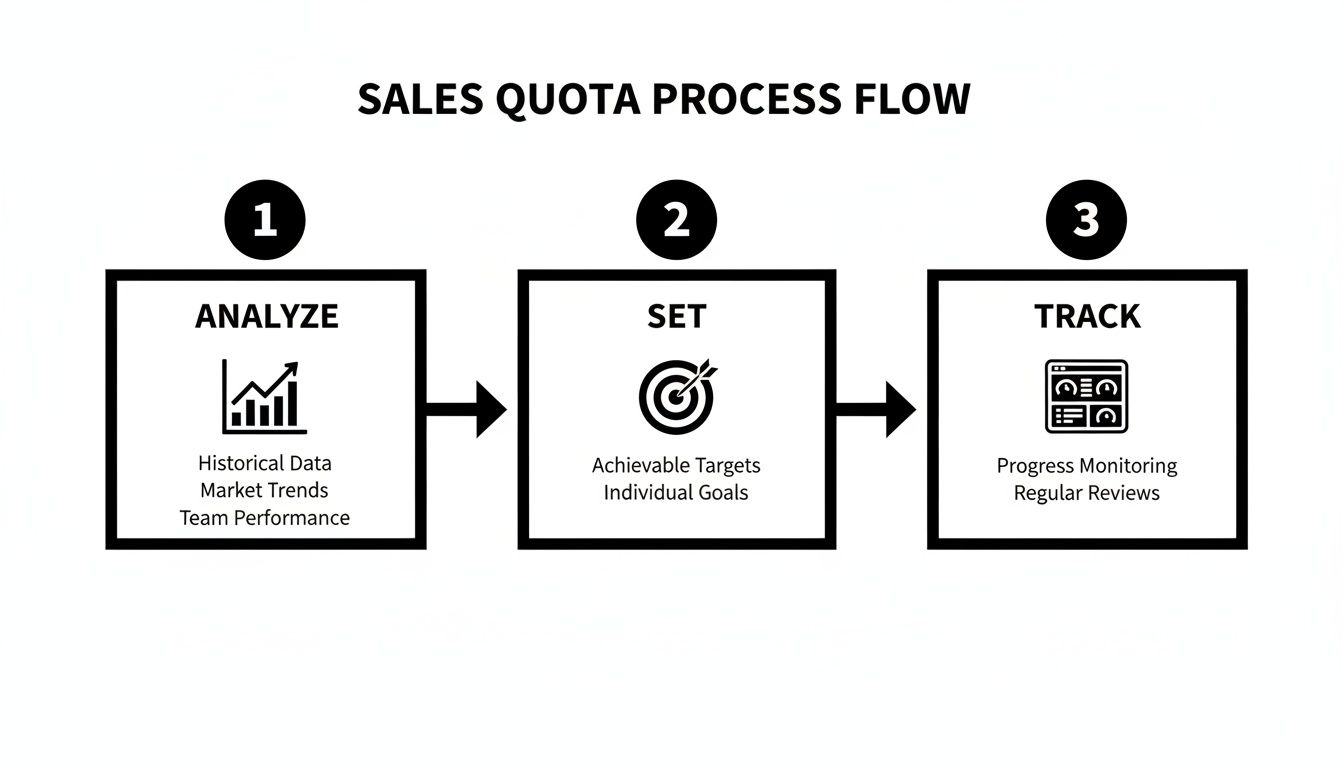
The best quotas are built from the bottom up, not handed down from the top. Start with the company’s revenue goal, then work backward using your team’s actual, historical performance data.
Here’s a more grounded, data-backed approach to setting quotas:
- Look at Historicals: What has an average rep realistically been able to close in a quarter? Use the performance of your middle 60% as the baseline—not your one rockstar who defies gravity.
- Consider the Territory: Are all territories created equal? Of course not. You have to factor in market size, the number of existing customers, and the quality of lead flow when assigning quotas. Fairness is key.
- Factor in Ramp-Up Time: If your average sales cycle is six months, it's completely unreasonable to expect a new hire to hit a full quarterly quota in their first 90 days. You need ramped quotas to set new reps up for success, not failure.
Ultimately, getting your metrics and quotas right is the foundation of effective sales management. It replaces ambiguity with clarity. Every single rep knows what success looks like and has a clear path to get there. That’s how you build a culture where everyone knows the score and is empowered to win.
Mastering Your Sales Pipeline for Predictable Revenue
Your sales pipeline is the lifeblood of your entire sales operation. When it's healthy and flowing, you get predictable revenue. Simple as that. But when it gets clogged with deals that aren't moving or stages that mean different things to different reps, your forecast becomes a wild guess and your team loses its edge.
To get a real grip on your team's performance, you have to standardize the pipeline. Everyone on the team needs to be speaking the same language. This means defining clear, non-negotiable stages that actually mirror the journey your buyer takes from "just looking" to "signed contract."
If you don't nail this down, one rep's "Qualified" lead could be another's "Initial Contact," and suddenly, your pipeline data is completely unreliable.
Defining Your Sales Pipeline Stages
While your sales process is unique to your business, most B2B sales cycles follow a pretty similar path. The real secret is to define strict entry and exit criteria for every single stage. A deal can only move to the next step when specific, verifiable actions have been completed.
A typical B2B pipeline structure might look something like this:
- Lead/Inquiry: A new name pops into your system. That's it. No qualification has happened yet.
- Marketing Qualified Lead (MQL): Marketing has done its job and confirmed the lead fits your ideal customer profile.
- Sales Accepted Lead (SAL): An SDR or AE has made that first call and confirmed there’s a real, potential opportunity worth exploring.
- Discovery Call Held: The first meaningful conversation has occurred. You've started to uncover their pains and goals. Exit criteria: The rep has confirmed budget, authority, need, and timeline (BANT).
- Solution Demo Scheduled: The prospect is bought-in enough to agree to a formal presentation of what you do.
- Proposal Sent: After a successful demo, you've sent over a formal quote or proposal with the scope and pricing.
- Negotiation/Review: The prospect is looking over the proposal and you're discussing the final terms. This is where deals often go to die, so having crystal-clear next steps is a must.
- Closed Won/Lost: The final outcome. You either celebrate or learn from it.
A well-defined pipeline is more than just a tracking tool—it's your best coaching asset. If you notice deals are constantly getting stuck at the 'Proposal Sent' stage, that’s your cue. It tells you the team needs help creating urgency or handling objections much earlier in the sales cycle.
Running Pipeline Reviews That Actually Help
Let's be honest, the weekly pipeline review is often the most dreaded hour of a salesperson's week. It doesn't have to feel like an interrogation. The key is to shift the focus from a high-pressure grilling session to a collaborative strategy huddle.
The goal isn't to ask, "Is it going to close?" The better question is, "What can we do together to move this deal forward?"
For these meetings to be truly productive, zero in on the deals that are stuck or at risk. Visual dashboards in your CRM are perfect for this, letting you spot problems at a glance.
A simple dashboard like this helps you immediately see the pipeline's value by stage. You can prioritize the conversation around your biggest opportunities and the roadblocks that need clearing.
Focusing on Strategic Account Management
In many B2B companies, a huge chunk of revenue comes from a small handful of key accounts. This is where strategic account management isn't just a nice-to-have; it's essential for growth. It’s the difference between being a transactional vendor and becoming a long-term, profitable partner.
First, you need to identify your accounts with the highest potential—and I'm not just talking about your biggest customers right now. Think bigger. Use criteria like their industry, company size, and potential for expansion with your other products or services.
Next, assign these key accounts to reps who excel at building relationships, not just closing quick deals. Their mission is to map out the entire organization, identify every key stakeholder, and deeply understand the company’s long-term business goals. This proactive approach turns your team from vendors into trusted advisors, uncovering growth opportunities that a purely transactional seller would never find.
Using Your CRM to Boost Sales Productivity

Let's be honest. Your CRM should be the central nervous system of your sales operation, not just a glorified digital address book. When set up right, it becomes a powerful engine that drives productivity. The goal is to make the CRM work for your reps, not the other way around.
Too often, sales teams see their CRM as a chore—a black hole for tedious data entry that pulls them away from actually selling. This mindset leads to spotty adoption and incomplete data, which makes the whole platform pretty useless for forecasting and management. Shifting this perspective is one of the most critical things you can do as a manager.
The first move is to pinpoint and slash the time-wasting admin tasks that bog your reps down. Just think about all the routine, manual work they do every single day.
Automating the Busywork to Free Up Selling Time
Every minute your reps spend on repetitive admin is a minute they aren't talking to customers. These little tasks pile up, creating a massive productivity drain across the team.
Just look at how most reps spend their week. Research consistently shows that sellers spend a shockingly small portion of their time on actual revenue-generating activities.
Typical Sales Rep Time Allocation (Weekly)
Here's a quick look at how a rep's time gets divided and where you can win back precious hours with smart automation.
| Activity | Average Time Spent | Opportunity for Automation |
|---|---|---|
| Active Selling (Calls, Demos, Meetings) | 35-36% | Low (This is what you want to increase!) |
| Email & Communication | 21% | High (Templates, sequences, logging) |
| Prospecting & Research | 17% | Medium (List building, data enrichment) |
| Data Entry & Admin | 17% | Very High (Automated logging, lead routing) |
| Internal Meetings & Training | 10% | Low (Essential for team alignment) |
As you can see, a huge chunk of the week is eaten up by tasks that are perfect candidates for automation. By tackling the low-hanging fruit, you can reclaim about five hours per week for each rep—a massive win that directly impacts quota attainment. For more on this, check out these productivity statistics on alore.io.
Here are a few no-brainers to automate in your CRM right now:
- Lead Assignment: Stop manually assigning new leads. Build rules that automatically route them to the right rep based on territory, industry, or company size.
- Follow-up Reminders: Set up workflows that create automatic tasks for reps, reminding them to follow up after a demo or when a deal has gone cold.
- Data Entry: This is the big one. Use integrations to automatically log emails, calls, and meeting notes from a rep’s inbox or calendar directly into the right contact record.
These automations don't just save time; they build a safety net. You get consistency, and high-value leads stop falling through the cracks. It frees up your reps to focus their brainpower on strategy and building relationships.
Driving CRM Adoption Across Your Team
Even with brilliant automation, a CRM is only as good as the data inside it. Driving adoption is all about demonstrating clear, undeniable value. Your reps need to see the platform as a tool that helps them close more deals and make more money. Simple as that.
Start by customizing your CRM to perfectly mirror your actual sales process. If your pipeline stages in the CRM don't match how your team talks about deals, they won't use it. The fields and dashboards should reflect the real-world information they need to do their jobs.
The key to CRM adoption is proving that it makes a salesperson's life easier. Show them how automated email sequences can nurture prospects while they sleep, or how a clean dashboard can instantly show them which deals to prioritize. When they see it as their personal sales assistant, adoption becomes a non-issue.
Make CRM proficiency a core part of your team's culture. Give shout-outs to reps who use it well and build your one-on-one coaching sessions around CRM data. If you’re just getting started on this journey, our guide on how to implement a CRM system is a great place to begin.
Ultimately, turning your CRM into a productivity hub is a game-changer. It gives you the visibility you need to coach effectively and gives your reps the tools they need to hit their numbers.
Building a World-Class Team with Coaching and Compensation
Forget the dashboards and forecasts for a minute. Your single biggest lever as a sales manager is your ability to make every rep on your team better. The truly great leaders are coaches first, managers second. They know how to find and unlock potential. This means getting past the weekly pipeline review and into the nitty-gritty of actual skill development.
Effective coaching isn’t about rah-rah speeches; it's a specific, data-driven process. When you get this right, you build a culture where everyone is constantly improving. Your B-players start performing like A-players, and your A-players find a whole new gear.
How to Run 1-on-1s That Actually Make an Impact
Your weekly one-on-one is the most important meeting on your calendar. It needs to be a dedicated strategy session for that rep's success, not just a verbal report of their pipeline. The secret is structure. A great 1-on-1 feels like a collaborative workshop, not an interrogation.
Here’s a simple framework that works:
- Let Them Drive First: Start by asking, "What's on your mind?" Let the rep lead the first part of the meeting. This empowers them to bring their biggest challenges to you, guaranteeing the time is valuable for them.
- Glance at the Metrics Together: Pull up their dashboard and look at the leading indicators—things like pipeline created, conversion rates between stages, and activity levels. Use the data to start a conversation. "Hey, I noticed deals seem to be stalling after the demo. What are you hearing from prospects at that stage?"
- Go Deep on One Key Deal: Don't try to review every opportunity. Pick one or two pivotal deals from their pipeline and really dig in. Brainstorm the next moves, talk through potential roadblocks, and strategize on how to get in front of other decision-makers.
- Zero In on One Skill: This is where the magic happens. Use a recent call recording or a specific scenario to give targeted feedback. The goal is to find one small, actionable thing they can work on this week.
True coaching is about diagnosis before prescription. Before you can improve a rep’s performance, you have to figure out exactly what's holding them back. Is it their discovery questions? Their objection handling? Their ability to create urgency?
Using Data and Tech for Smarter Coaching
Modern sales tools give us an incredible advantage. Call recording software, for example, is a goldmine for coaching. Instead of relying on a rep's shaky memory of a call, you can listen to the real thing together. You can pinpoint the exact moment a deal went south or highlight a perfectly executed closing line.
On top of that, many platforms now have predictive sales AI that can analyze call data for you. This tech can spot trends across the whole team, like which competitor keeps coming up or which opening lines lead to longer conversations. It's powerful stuff that gives your coaching a sharp, data-backed edge.
The payoff for this kind of focused development is huge. Teams that provide consistent, structured coaching see up to a 353% ROI on that investment. And according to research from Hyperbound, ongoing, simulation-based coaching can boost net sales per employee by as much as 50%. You can discover more insights about these sales training statistics on hyperbound.ai.
Designing a Comp Plan That Actually Motivates
Coaching builds skills, but compensation is what directs those skills toward the right business goals. A smart comp plan is one of the most powerful tools you have to align your team's ambition with the company's objectives. A bad one, on the other hand, just creates toxic competition and rewards all the wrong behaviors.
Your goal should be a plan that’s simple, directly tied to the actions you want to see, and feels fair to everyone.
The Core Components of a Strong Comp Plan
A solid B2B sales compensation plan needs a few key ingredients to provide stability while rewarding over-performance.
- Base Salary: This is the foundation. It provides financial security, which allows reps to focus on building long-term value instead of frantically chasing small, quick deals to pay their rent. For roles with long and complex sales cycles, a good base salary is non-negotiable.
- Commission: This is the engine. It absolutely must be uncapped to motivate your top performers to blow their numbers out of the water. You can structure it as a simple percentage of revenue or, even better, gross margin.
- Accelerators and Bonuses: These are the rocket fuel. Accelerators are tiered commission rates that kick in after a rep hits their quota (e.g., 10% commission up to quota, then 15% on everything after). Bonuses can be tied to specific goals, like landing a key logo or hitting a team-wide target, which is a great way to encourage collaboration.
At the end of the day, your comp plan is a megaphone broadcasting what really matters to the business. If you need new logos, reward that heavily. If retaining and growing existing accounts is the priority, build incentives for that into your account managers' plans. When you combine thoughtful coaching with a smart compensation strategy, you build a team that is not just skilled, but genuinely motivated to win.
Common Questions from the Sales Manager's Desk
Even with the perfect playbook, managing a sales team means you're constantly dealing with people. And people are complicated. How you handle the tough situations that pop up daily can mean the difference between a small bump in the road and a full-blown team meltdown.
Here are some of the most common questions I hear from other sales managers, along with my straight-up answers.
How Do You Handle an Underperforming Sales Rep?
When a rep is falling behind, it’s easy to jump to conclusions like "they aren't working hard enough." But that's rarely the full story. The real issue could be a skill gap they're embarrassed about, a major confidence crisis after losing a few deals, or even something personal happening outside of work.
Your first move should be a quiet, one-on-one conversation, with their CRM dashboard open right in front of both of you. Don't make it about feelings; make it about the data. Look at their leading indicators together—call volume, new pipeline created, conversion rates between stages. This immediately takes judgment out of the equation and puts the focus on specific, measurable activities.
From there, you can build a Performance Improvement Plan (PIP). And no, this isn't just a formal step before firing someone. A good PIP is a lifeline—a clear, supportive path to get them back on track.
- Set Clear, Small Wins: Give them a few achievable goals for the next 30-60 days. Think things like, "Let's increase your scheduled discovery calls by 15%," or "Let's get that demo-to-proposal conversion rate up from 20% to 25%."
- Double Down on Support: This is where you really show you're on their side. Schedule more frequent check-ins. Offer to jump on calls with them or run through a few role-playing scenarios.
- Be Direct About What's Next: Transparency is key. Clearly lay out the expectations and what happens if the goals aren't met.
The entire point is to show them you’re invested in their success, not just managing their failure.
An underperforming rep isn't a problem; they're a coaching opportunity. When you dig into the root cause with data and a solid plan, you turn a negative situation into a positive one. You either help them find their footing again or you make a necessary change with confidence and clarity.
What Are the Real KPIs a B2B Sales Team Should Live By?
If you're only looking at revenue, you're driving your team by looking in the rearview mirror. You need a balanced mix of metrics that tell you not just what happened last quarter, but what's going to happen next quarter.
I break my KPIs into two simple buckets:
- Lagging Indicators: These are the results, the output of your team's work. The big one here is obviously Total Revenue. It’s essential for the board meeting, but it’s useless for making adjustments in the middle of a tough month.
- Leading Indicators: These are the inputs—the activities that predict future success. This is your early-warning system, and frankly, it's where you should spend most of your time.
Here are the leading indicators I'm absolutely obsessed with:
- Pipeline Coverage: This is your pipeline's value compared to your quota. I sleep a lot better at night when my team is sitting at a healthy 3x to 4x ratio. It tells me we have enough at-bats to hit our number.
- Lead Response Time: In sales, speed kills the competition. This metric shows how fast we're jumping on new inbound leads. If this number creeps up, conversions will creep down. It's a direct cause and effect.
- Conversion Rate by Stage: This is my X-ray into the sales process. It instantly shows me where deals are getting stuck. Is everyone great at demos but terrible at the proposal stage? This metric tells me exactly what to focus on in our next team training.
- Sales Cycle Length: How long does it take us to close a deal, from first touch to signed contract? If this starts getting longer, it's a red flag. It could be a problem with our process, our pricing, or even a shift in the market.
Checking these numbers every single week allows you to spot trouble and fix it long before it ever has a chance to mess with your final revenue goals.
How Can I Build a Sales Culture That’s Both Competitive and Collaborative?
Sales has a reputation for being a lone-wolf, dog-eat-dog world. But the truly elite teams have a culture of what I call "coopetition"—that perfect blend of healthy competition and genuine cooperation. You want your reps hungry to hit the top of the leaderboard, but you also need them to share what’s working and help a teammate who’s struggling.
It all starts with how you design your goals and compensation.
Individual commission is a must, of course. But you should also layer in team-based incentives. A simple one is offering a big team bonus or a killer outing if the entire team hits 110% of the quarterly quota. Suddenly, your top reps have a very real reason to care about whether the new person is hitting their number.
You also have to create space for collaboration to happen naturally. I like to ask my most successful reps to lead quick, 15-minute sessions in our team meetings to share a tactic that’s crushing it for them. When we do pipeline reviews, I don't just talk to one rep; I open it up to the room and ask, "Okay team, what would you do here? How can we help Sarah get this deal across the line?"
When you celebrate individual wins and team victories, you create a powerful dynamic where everyone is pulling in the same direction.