Are your sales cycles all over the place? Do you have deals that seem promising one day, only to completely stall out the next? If that sounds familiar, you're definitely not alone. The secret to fixing this isn't just about working harder—it's about working smarter with a well-defined set of B2B sales pipeline stages.
This framework turns a simple to-do list into a strategic roadmap, paving the way for consistent, predictable growth.
Your Blueprint for Predictable Revenue
Think of your sales pipeline like an assembly line. Raw materials (in this case, leads) enter at one end, and through a series of methodical steps, they're transformed into a finished product: a closed deal. Each stage represents a critical checkpoint where value is added and the opportunity is qualified, moving it closer to the finish line.
Without a formal process, chaos takes over. Your reps might all be doing their own thing, deals get stuck for reasons nobody can pinpoint, and forecasting revenue feels more like a guessing game than a science.
A clearly defined pipeline changes all that by creating a universal language for your sales team. Everyone understands exactly what needs to happen for an opportunity to advance from one stage to the next.
This clarity delivers some massive benefits:
- Better Forecasting: By knowing the probability of closing a deal at each stage, you can predict future revenue with far more accuracy.
- Stronger Team Performance: Reps know the precise actions required at every step, which boosts both their efficiency and accountability.
- Pinpoint Bottlenecks: You can easily see where deals are getting stuck, allowing you to step in and fix the problem before it's too late.
- Scalable Growth: A documented, repeatable process makes it much easier to train new hires and scale up your entire sales operation.
In B2B sales, a structured pipeline is a total game-changer. This is especially true for SMEs navigating complex deals that can involve 11 to 20 decision-makers and stretch over 6 to 12 months. When buyers are doing 72% of their research before ever speaking to a sales rep, a rock-solid internal process is non-negotiable.
The numbers don't lie. A staggering 40% of businesses miss revenue goals because of poor pipeline management. On the flip side, companies with a formal sales process achieve 28% higher revenue than those winging it. You can learn more about the impact of pipeline management on B2B success and see why it matters so much.
A B2B sales pipeline isn't just a tool for tracking deals; it's a system for controlling the entire sales process. It turns reactive selling into proactive revenue generation by giving you a clear, step-by-step blueprint for turning a lead into a loyal customer.
This guide will break down the essential stages of a high-performing pipeline. We'll show you exactly how to build a system that eliminates unpredictability and becomes the engine for your company's growth.
Unpacking the 7 Core B2B Sales Pipeline Stages
Think of your B2B sales pipeline like a road trip. You can't just teleport to the final destination (a closed deal); you have to pass through several key cities and checkpoints along the way. Each of these stops is a B2B sales pipeline stage.
Putting a name to each stage does more than just organize your CRM. It creates a universal language for your entire sales team, making it crystal clear what needs to happen before an opportunity can move to the next step.
This simple act of defining your process is what takes you from the chaos of random sales activities to a predictable engine for growth.
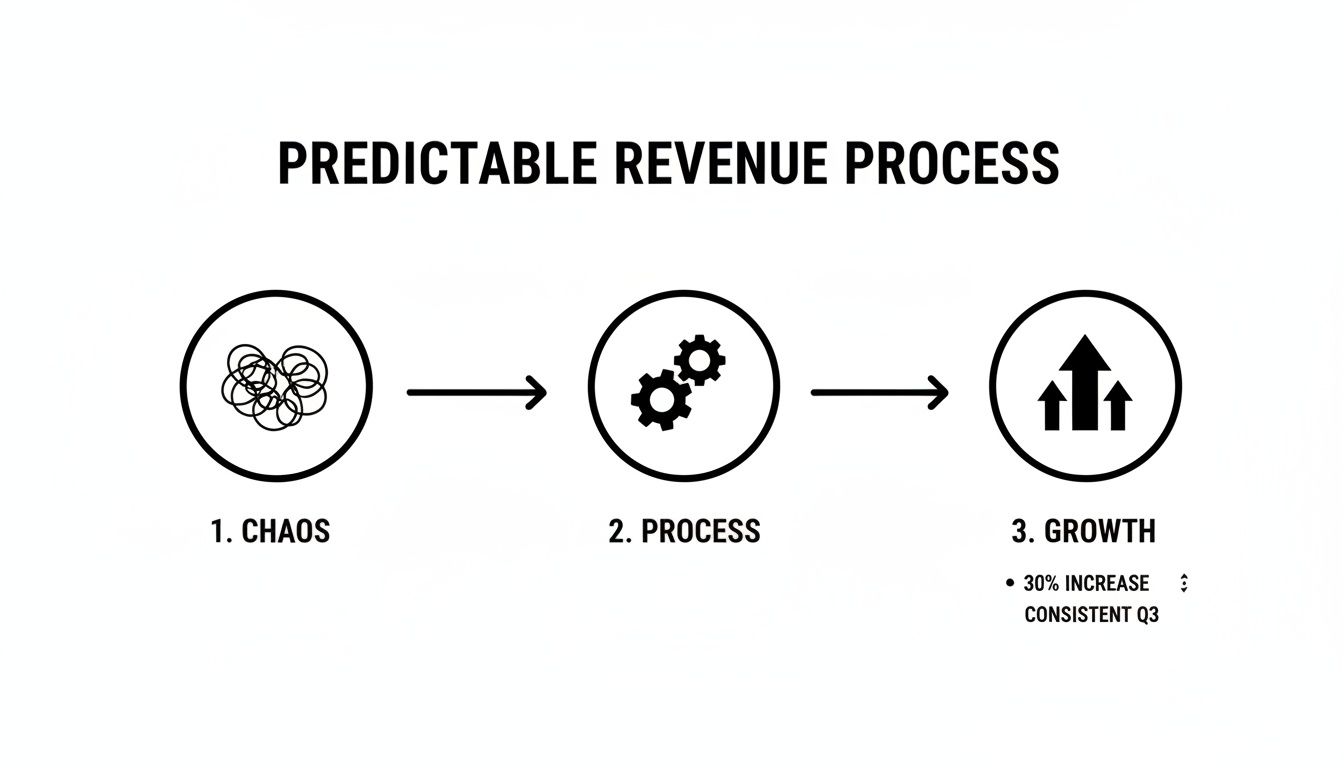
This journey from chaos to a well-oiled machine is the bedrock of building a business with predictable revenue. Now, let's walk through the seven essential stages that make up nearly every high-performing B2B sales pipeline.
The 7 B2B Sales Pipeline Stages At-a-Glance
Before we dive into the details, this table gives you a quick snapshot of the entire journey. It lays out what each stage is for, what your reps are actually doing, and the one key question they must answer to keep the deal moving.
| Stage Name | Primary Goal | Example Sales Activities | Exit Criteria Question |
|---|---|---|---|
| Prospecting | Build a list of potential good-fit accounts. | Cold calling, emailing, social selling, attending events. | "Does this company fit our Ideal Customer Profile?" |
| Lead Qualification | Determine if a lead has a legitimate problem you can solve. | Discovery calls, running BANT or MEDDPICC frameworks. | "Is there a real, acknowledged business pain here?" |
| Needs Analysis | Deeply understand the prospect's challenges and goals. | In-depth discovery sessions, stakeholder interviews. | "Do we fully grasp the 'what' and 'why' of their problem?" |
| Solution Presentation | Demonstrate how your product solves their specific problem. | Customized product demos, solution walkthroughs. | "Does the prospect believe our solution will work for them?" |
| Proposal | Formally outline the solution, price, and terms. | Sending a detailed quote, scope of work document. | "Is the proposed value greater than the cost?" |
| Negotiation & Closing | Finalize terms and get the contract signed. | Handling objections, redlining contracts, final calls. | "Are all stakeholders ready to sign?" |
| Onboarding | Ensure a smooth transition from prospect to happy customer. | Kickoff calls, account setup, initial training. | "Is the customer set up for immediate success?" |
This table provides the map for your pipeline. Now, let's explore what each of these "stops" on the map looks like in the real world.
1. Prospecting
This is ground zero. Prospecting is all about actively identifying potential customers that look a lot like your best existing customers—what we call an Ideal Customer Profile (ICP). It’s about finding the right businesses and, just as importantly, the right people inside them who stand to gain the most from what you offer.
Your prospecting efforts will likely be a mix of two approaches:
- Inbound: These are leads that come to you. They might have downloaded an ebook, signed up for a webinar, or requested a demo on your website.
- Outbound: This is your team doing the hunting. They’re proactively reaching out through cold calls, targeted emails, or connecting on LinkedIn.
The goal here isn't just to fill the pipeline; it's to fill it with the right opportunities. A pipeline packed with poor-fit prospects is a recipe for wasted time and missed quotas.
2. Lead Qualification
Once a prospect is on your radar, the next step is to qualify them. Think of this stage as the bouncer at the club door—their job is to make sure only the right people get in. Your sales team's time is their most precious resource, and qualification protects it fiercely.
This is where you sift the tire-kickers from the serious contenders. To add some structure to this, most top-tier sales teams use a qualification framework. You’ve probably heard of them:
- BANT: A classic framework focusing on Budget, Authority, Need, and Timeline.
- MEDDPICC: A more robust, enterprise-focused framework covering Metrics, Economic Buyer, Decision Criteria, Decision Process, Paper Process, Identify Pain, Champion, and Competition.
A lead graduates from this stage once you've confirmed they have a real, painful business problem that your solution is uniquely positioned to solve. Nail this stage, and you'll see your win rates climb dramatically.
3. Needs Analysis
With a qualified lead in hand, it's time to go deep. The Needs Analysis stage is less about selling and more about consulting. You're shifting from "Are you a fit?" to "How can we help?"
Here, your sales rep's most important skill is listening. They need to ask sharp, insightful questions to uncover the full scope of the prospect's challenges, their business goals, and the nitty-gritty details of their current situation. The objective is to quantify the pain—what is this problem really costing them in time, money, or opportunity?
4. Solution Presentation
Now that you have a thorough understanding of their world, you can finally show them your solution. This is the classic "demo" stage, but it should be anything but a generic product tour.
A great presentation is a story. It directly connects the specific pains you uncovered in the Needs Analysis stage to the specific features and benefits of your product. You're not just showing them what your tool does; you're showing them exactly how it will make their life better and help them hit their goals.
5. Proposal
After a presentation that gets the prospect nodding along and excited, it's time to make it official. The proposal stage is where you send a formal document that lays out the entire deal on paper.
This document should be comprehensive, covering the exact scope of work, detailed pricing, legal terms, and a clear implementation plan. There should be zero ambiguity. This is the document stakeholders will pass around internally as they make their final decision.
6. Negotiation and Closing
This is the final mile. Once the proposal is out, you can expect some back-and-forth. The prospect might have questions about the terms, push back on pricing, or need to loop in their legal team.
A skilled sales rep navigates this stage by handling objections, reinforcing value, and guiding all the key players toward a final "yes." This stage officially ends when the ink is dry on the contract and you've welcomed a new customer. It’s the moment everything has been building towards.
7. Onboarding
Too many sales pipelines end at "Closed-Won." That’s a huge miss. The best B2B companies know that the sale is just the beginning of the relationship. The final, crucial stage is a seamless handoff to the customer success or implementation team.
Onboarding involves everything from the official kickoff call and account setup to initial training. A fantastic onboarding experience gets the customer to see value from your solution as quickly as possible, which is the single best way to prevent churn and pave the way for future loyalty and expansion revenue.
Bringing Your Sales Pipeline to Life in a CRM
A sales pipeline on paper is a good starting point, but it doesn't become truly powerful until you bring it to life inside your Customer Relationship Management (CRM) system. This is where the rubber meets the road—where your well-defined process becomes a dynamic, visual tool your sales team can actually use every day.
The idea is to perfectly mirror your B2B sales pipeline stages within the CRM. This creates a single source of truth that transforms abstract steps into a concrete workflow, helping reps manage their deals and giving leadership a clear view of the entire revenue picture.
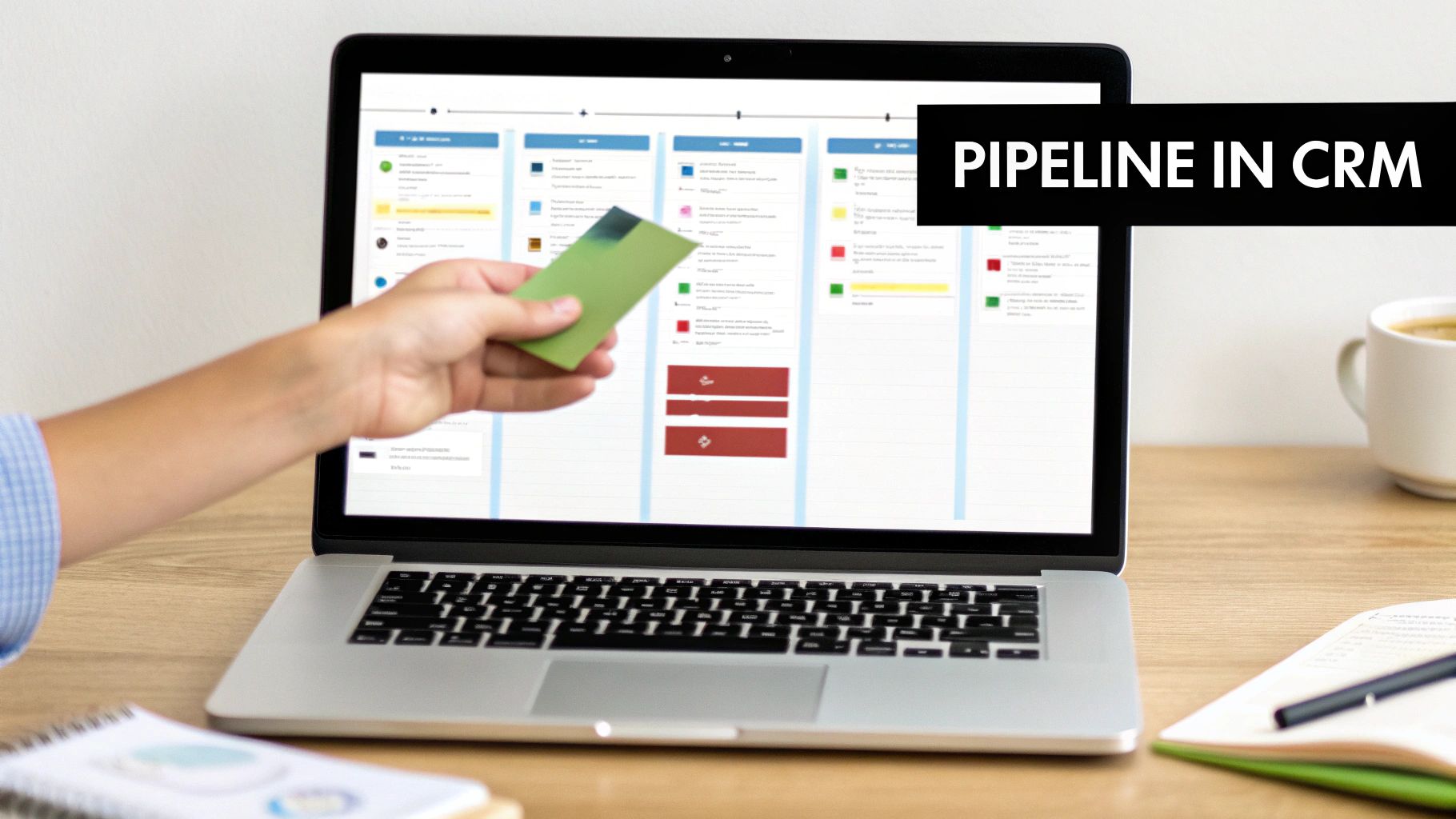
With this kind of visual setup, a sales manager can see how deals are moving at a glance, instantly spot bottlenecks where things are slowing down, and coach their team far more effectively.
Structuring Your Pipeline with a Kanban Board
One of the best ways to visualize your sales pipeline is with a Kanban board. Just think of it as a digital whiteboard. Each of your sales stages gets its own column, and every deal is a card that you can literally drag and drop from one stage to the next as it moves forward.
This view gives you immediate clarity. You know exactly how many deals are in each stage, what their potential value is, and where your team is focusing its efforts. It’s an incredibly simple and intuitive way to manage what can otherwise be a very complex process.
Getting this set up is straightforward:
- Define Your Deal Stages: Head into your CRM settings, create a new pipeline, and add columns that directly match your seven stages, from "Prospecting" all the way to "Onboarding."
- Assign Win Probabilities: For each stage, assign a "win probability" percentage. This is you telling the CRM how likely a deal in that stage is to close, which is absolutely essential for accurate sales forecasting. For example, a deal in the "Proposal" stage might have a 60% probability, while one in "Negotiation" could be up to 80%.
- Establish Advancement Rules: Create hard-and-fast rules for what it takes to move a deal forward. For instance, a deal can't be moved from "Lead Qualification" to "Needs Analysis" until key information like "Budget Confirmed" and "Decision-Maker Identified" has been filled out in the CRM.
A well-configured CRM doesn't just track activity; it enforces your sales process. By setting clear rules for stage advancement, you ensure that every deal in the pipeline is properly vetted, which dramatically improves data quality and forecast accuracy.
If you're just starting out, it’s worth checking out a full guide on how to implement a CRM system to make sure you're building on a solid foundation.
Supercharging Your Stages with Automation
Now for the fun part. This is where your CRM stops being just a record-keeping tool and starts acting like a powerful sales assistant. By setting up automation triggers, you can get rid of all those repetitive manual tasks and make sure no opportunity ever falls through the cracks.
This frees up your reps to focus on what they do best: selling.
Just think about what you could automate:
- When a deal moves to "Proposal": The CRM can automatically create a task reminding the rep to follow up in three days. No more sticky notes.
- When a new lead is assigned: An automated welcome email can be sent out immediately from the assigned rep, kicking off the relationship right away.
- If a deal sits idle for too long: The system can flag the deal or send a notification to the sales manager, preventing a promising opportunity from going cold.
These small automations build consistency and efficiency across your entire team. They make sure the right actions happen at the right time for every single deal, turning your defined B2B sales pipeline stages into a smooth, automated workflow that just plain works.
Measuring What Matters for Pipeline Health
Getting your sales pipeline set up in a CRM is a great start, but it's really just the beginning. To actually have control over your revenue, you need to understand what’s happening inside that pipeline. Think of it like a doctor checking a patient's vitals—you can't know if they're healthy or sick without looking at the data.
When you track the right numbers, you move past just counting deals. You start spotting weaknesses, figuring out why things are stuck, and making smart decisions that keep deals moving. Instead of guessing why you missed last quarter's target, you'll know exactly which stage is the bottleneck.
The Key Performance Indicators for Your Pipeline
There are four core metrics every B2B sales leader should have on their dashboard. These KPIs give you a complete picture of your pipeline’s health, from how fast deals close to how much they're worth. Keeping a close eye on them is the secret to predictable growth.
- Sales Cycle Length: This is the average time it takes for a deal to go from that very first touchpoint all the way to a signed contract. If this number starts creeping up, it’s a sign that there’s friction somewhere in your process or that reps are getting bogged down in a specific stage.
- Average Deal Size: It's as simple as it sounds—the average revenue you bring in from each deal you win. Tracking this helps you see if you're going after the right types of accounts and whether the value of your deals is trending in the right direction.
- Stage Conversion Rate: This metric tells you the percentage of deals that successfully make it from one stage to the next. For example, a low conversion rate between "Solution Presentation" and "Proposal" is a huge red flag. It probably means your demo or value prop isn't hitting the mark.
- Sales Velocity: This is the ultimate health metric. It rolls the other three into one number to show you how much revenue you're generating per day. It’s basically your business’s revenue speedometer.
These are just the fundamentals. To get a more granular view, check out our complete guide on other crucial sales performance metrics examples that can give you even more visibility.
Demystifying Sales Velocity
Of all the metrics, Sales Velocity is easily the most powerful because it gives you a holistic view of how efficiently your pipeline is working. It answers the simple question, "How fast are we making money?" The formula might look a little complex at first, but the idea behind it is straightforward.
Sales Velocity measures the speed at which deals move through your pipeline and generate revenue. A higher velocity means you are closing more deals, for more money, in less time—the trifecta of sales success.
For B2B teams, simply knowing how deals progress is important, but sales pipeline velocity takes it a step further. It's calculated as (Number of Opportunities × Win Rate × Average Deal Size) / Sales Cycle Length.
Let’s say you have 50 opportunities, a 20% win rate, a $10,000 average deal size, and a 70-day sales cycle. Your sales velocity is $1,428 per day. You can learn more about how to use this revenue speedometer on salesintel.io.
Using Your CRM to Track Pipeline Health
Trying to calculate all these metrics in a spreadsheet is a recipe for a headache—not to mention human error. This is where your CRM becomes your most valuable player. A properly set up CRM dashboard makes tracking these KPIs practically effortless.
With just a few clicks, you can build reports that show you:
- The average time deals are spending in each stage, so you can spot bottlenecks instantly.
- Conversion rates between every single stage, showing you exactly where deals are dropping off.
- Your overall Sales Velocity, updated in real time.
This live visibility lets you stop reacting to what happened last month and start proactively managing your pipeline today. When you see a problem brewing, you can step in immediately—whether that means coaching a rep who's struggling or tweaking the exit criteria for a stage that's causing deals to stall. Your CRM dashboard becomes your command center for growing revenue.
Improving Conversions and Forecasting Accuracy
Knowing your pipeline's health is one thing; tuning it up is another. It’s like getting a diagnostic report for your car—now it’s time to get under the hood and make the adjustments that lead to better performance. Optimizing your B2B sales pipeline stages isn't about guesswork; it's about making precise, data-backed changes that create predictable growth.
The big goal here is simple: get more deals to move from one stage to the next. This always starts with tightening up your entry and exit criteria for each stage. When your qualification rules are fuzzy, reps end up chasing deals that were never going to close, which kills conversion rates and morale.
A classic friction point is the handoff from Sales Development Reps (SDRs) to Account Executives (AEs). You absolutely have to get this right. AEs need to receive opportunities that are genuinely ready for a serious sales conversation, which means SDRs must gather specific, agreed-upon information before that handoff ever happens.
Mastering Pipeline Coverage
One of the most powerful, yet simple, metrics for better forecasting is Pipeline Coverage. It’s just a ratio comparing the total value of all your open deals to your sales quota for the quarter or year.
Think of it as a safety net for your revenue goal. If your quota is $100,000, having exactly $100,000 in your pipeline is a recipe for anxiety. We all know not every deal closes, so you need a buffer.
Most top-performing sales teams aim for a pipeline coverage ratio of 3x to 4x. So, to feel confident about hitting that $100,000 quota, you'd want to keep between $300,000 and $400,000 in qualified opportunities active in your pipeline. Tracking this ratio gives you an instant reality check—do you have enough fuel in the tank to reach your destination?
The Power of Weighted Forecasting
This is where your CRM really starts to shine, turning from a contact list into a genuine prediction tool. A weighted forecast assigns a win probability to each stage of your pipeline, giving you a far more realistic picture of future revenue.
Instead of just adding up the full value of every deal, you apply percentages based on historical data. For instance, you might know that deals in your "Qualification" stage have a 20% chance of closing, while deals that have made it to the "Proposal" stage jump to a 60% probability.
Your CRM does the math for you, multiplying the deal value by the stage probability to get a "forecasted value." This method removes some of the happy-ears optimism from your forecast and grounds it in reality. For a deeper dive into different approaches, you can check out these sales forecasting examples.
Here's a quick look at how this plays out in a real-world scenario.
Example Weighted Sales Forecast
This table shows how applying probabilities gives you a much more reliable forecast than just looking at the total potential deal value.
| Deal Name | Deal Value | Pipeline Stage | Probability (%) | Forecasted Value |
|---|---|---|---|---|
| Alpha Corp | $50,000 | Proposal | 60% | $30,000 |
| Beta Solutions | $25,000 | Qualification | 20% | $5,000 |
| Gamma Inc. | $75,000 | Negotiation | 80% | $60,000 |
| Total | $150,000 | $95,000 |
See the difference? The simple sum of all deals is $150,000—an exciting number, but one that's probably not going to happen. The weighted forecast of $95,000 is a much more sober and dependable figure to use for planning.
By consistently using these techniques, you shift from just reacting to sales results to proactively steering your revenue engine with data.
Of course. Here is the rewritten section, designed to sound like it was written by an experienced sales leader.
Your Top B2B Sales Pipeline Questions, Answered
Knowing the textbook definitions of pipeline stages is one thing. Actually building and managing one in the chaos of day-to-day sales is another. Let's be honest, every sales team is different, and what works for a SaaS startup won't be a perfect fit for a manufacturing firm.
Here, we'll tackle some of the most common questions and points of confusion that I see trip up sales leaders and their teams. Getting these fundamentals right is what turns a pipeline from a glorified spreadsheet into a true revenue-generating engine.
How Many Stages Should My B2B Sales Pipeline Have?
While the seven-stage model we've covered is a solid starting point, let me be clear: there’s no magic number. The best pipeline is the one that actually maps to how your customers make a buying decision.
For most B2B outfits, a pipeline with five to eight stages is the sweet spot. The key isn't the number of stages, but whether each stage represents a real, tangible step forward in the deal.
Here’s where a lot of teams go wrong:
- It’s too vague. Stages named "In Progress" or "Contacted" are deal graveyards. They don't reflect any commitment from the buyer, making your pipeline a messy parking lot for deals with no clear path forward.
- It’s too complicated. On the flip side, creating stages for every little task—like "First Call," "Second Call," and "Follow-up Email Sent"—drowns your team in admin work. It adds complexity without giving you any real insight.
My advice? Start with the classic seven stages and then tailor them. For every stage you create, ask yourself: Does moving to this stage require a specific action from the buyer? Does it signal a real shift in their mindset? A good CRM, like B2B CRM, lets you easily add, remove, and rename stages until they perfectly mirror your sales reality.
What Is the Difference Between a Sales Pipeline and a Sales Funnel?
This is a big one. People use these terms interchangeably all the time, but they represent two totally different views of the world. Getting this right is crucial.
Think of it this way:
A sales funnel is the buyer's journey. It’s a marketing concept, looking at the world from the customer's perspective. It starts wide at the top (with all the people who are vaguely aware you exist) and gets narrow at the bottom (the few who actually buy). A funnel tracks the quantity of anonymous leads.
A sales pipeline, on the other hand, is the salesperson's journey. It’s the set of concrete actions your team takes to move a qualified prospect toward a signature. A funnel might have thousands of website visitors; a pipeline tracks the value and progress of specific, named deals your reps are actively working. Your CRM is built to manage the pipeline, not the funnel.
How Can I Fix a Stalled Sales Pipeline?
Nothing is more frustrating than a pipeline where deals just sit there, gathering dust for weeks or even months. It kills your team's momentum and makes forecasting a complete guessing game. Fixing it starts with a diagnosis.
First, dig into your CRM data to find the bottleneck. Where are deals getting stuck? Look at the "time in stage" metric for each step.
- Are deals piling up in the "Proposal" stage? That could mean your pricing is a mess, your value prop isn't landing, or you're not talking to the real decision-maker.
- Is everything stuck in "Needs Analysis"? Maybe your reps need more training on how to ask the tough discovery questions that uncover real, urgent pain.
Once you know where the logjam is, the fix is to enforce strict exit criteria for each stage. For example, a deal can't move from "Needs Analysis" to "Solution Presentation" until the rep has confirmed the budget, timeline, and key decision-maker and logged it in the CRM.
Finally, use your CRM's automation to your advantage. Set up alerts that ping a rep or a manager when a deal has been idle for too long. A simple nudge can be all it takes to get things moving again.
What Is the Most Important Stage in the B2B Pipeline?
If you ask ten veteran sales leaders this question, nine of them will give you the same answer: Lead Qualification. While every stage matters, this one has the biggest downstream impact. Why? Because the quality of what you let into your pipeline determines the quality of everything that comes out.
A pipeline clogged with unqualified, poor-fit leads is a recipe for failure. It directly causes:
- Wasted time and energy from reps chasing ghosts that were never going to buy.
- A frustrated, burned-out sales team that can't hit its numbers.
- Laughably inaccurate sales forecasts that destroy your credibility with leadership.
Think of your qualification process as a bouncer at an exclusive club. It ensures your reps spend their valuable time only on prospects who have a real problem you can solve, the authority to buy, a realistic budget, and a reason to act now. Get disciplined at this first step, and you'll see win rates climb, sales cycles shrink, and your entire process become more predictable. A weak qualification process poisons the well from the very beginning.