If you want to get good at handling sales objections, you have to completely change how you think about them. Stop seeing them as a rejection. Instead, see them for what they really are: a request for more information. The secret is to listen carefully, figure out the real issue, and respond with value—not a defensive comeback. This simple switch turns a confrontation into a problem-solving partnership.
Why Objections Are Really Buying Signals

Let's be real. When a prospect says, "Your price is too high," it can feel like a punch to the gut. The knee-jerk reaction is to get defensive or just feel defeated. But the best salespeople I know see it differently. They know that an objection is actually a sign of engagement.
A truly uninterested prospect won't bother objecting. They'll just go quiet. Silence is the real enemy in sales, not a tough question. An objection means they were actually listening, thinking about what you said, and are invested enough to push back. They are, in fact, participating in the sales process.
The Psychology Behind Buyer Concerns
Put yourself in their shoes for a second. Making a big B2B purchase is risky. They have to justify the cost, prove the ROI to their boss, and deal with the fallout if the solution fails. So, an objection is often just their way of asking for help to de-risk the decision.
When you hear a concern, they're really asking for your help to connect the dots.
- "It costs too much" is usually code for, "Help me understand why the value is worth this price."
- "We're happy with our current provider" often means, "Convince me that the pain of switching is worth it."
- "I need to talk to my team" is frequently a plea: "Give me the ammo I need to sell this internally."
This shift in perspective is everything. You're not trying to win an argument. You're a guide, helping them make a good, safe decision that will make them look smart. Your job is to listen, clarify, and build a bridge from their concern to their goal.
Turning Roadblocks into Conversations
Getting good at this isn't about memorizing clever one-liners for every possible objection. It’s about building the skill to turn that moment of friction into a real conversation that builds trust. When you welcome an objection, you’re showing confidence in what you sell and respect for their process.
This approach changes the entire feel of your sales calls. Instead of dreading objections, you'll start looking forward to them as chances to really prove your value and show why you're different. A good B2B CRM is your secret weapon here, giving you the context from past conversations and stakeholder notes so you can address these points with confidence and turn roadblocks into signed deals.
Decoding the Four Types of Sales Objections

When a prospect pushes back, it’s easy to get defensive or jump straight into a rebuttal. But hold on. An objection isn't a rejection; it's a request for more information, just poorly worded. They're giving you a breadcrumb trail that leads directly to their biggest hesitation.
Your first move isn't to talk, it's to listen and categorize. Every single objection you'll ever hear in B2B sales boils down to one of four core issues. Figuring out which bucket their concern falls into is the key to addressing the real problem, not just the words they're saying.
Price and Budget Objections
This is the classic, the one everyone expects. But when a prospect says, "It's too expensive," they rarely mean they literally can't afford it. What they're usually saying is, "You haven't shown me why it's worth this much."
It’s a value gap. Plain and simple.
- "Your price is just too high for our budget."
- "We can get something similar from Competitor X for a lot less."
- "Whoa, that's more than we were expecting to spend."
- "It's not in the budget this quarter."
Hearing any of these is a bright, flashing signal to stop talking about features and start talking about outcomes. The prospect can't connect the dots between your price and their ROI. It's your job to draw the line for them, focusing on efficiency gains, cost savings, or the tangible business impact your solution will have.
Authority and Timeline Objections
These objections are all about process and priorities. The person you're speaking with either doesn't have the final say, or you haven't made a compelling enough case for them to act now.
Think of these as process roadblocks.
- "I'll need to run this by my boss."
- "This isn't really a priority for us right now."
- "Give me a call next quarter."
- "We just have too much on our plate to think about a new implementation."
These are your cues to do one of two things: either map out the organization to get to the real economic buyer or build a much stronger sense of urgency. You need to clearly articulate the cost of doing nothing and tie your solution directly to one of their top-tier business goals.
Need and Fit Objections
With these, the prospect is basically asking, "Is this really for us?" They might be perfectly content with what they're doing now, or they believe your product doesn't quite match their unique workflow. This is a direct challenge to how well you did your discovery.
These are relevance questions.
- "We're already using a different provider and we're happy."
- "I'm not sure this will integrate with our current tech stack."
- "It doesn't have that one specific feature we absolutely need."
- "We tried a tool like this a couple of years ago, and it was a disaster."
An objection about 'fit' is a golden opportunity. It shows the prospect is mentally trying to picture your solution inside their company. Your task is to show them exactly how it clicks into place by using relevant case studies or demonstrating a specific workflow.
This is your moment to lean in, ask even better questions, and prove you've been listening. You need to show them how your solution isn't just a generic product, but a specific, tailored answer to their problem.
Trust and Risk Objections
At the end of the day, people buy from people—and companies—they trust. If a buyer is worried about your company's reputation, your ability to deliver, or the risk of making a bad call, they'll slam on the brakes. These objections come from a place of fear.
This category is all about building credibility.
- "To be honest, I've never heard of your company."
- "I saw a negative review about you online."
- "How do I know we'll actually get the results you're promising?"
- "I'm not comfortable signing a long-term contract."
To handle these, you have to de-risk the decision for them. Social proof is your best friend here. Bust out the testimonials, share relevant case studies, and offer up customer references. Your job is to patiently build their confidence and prove you're a partner they can count on.
To help you quickly diagnose what you're hearing on a call, here's a quick reference table.
Common B2B Sales Objections and Their Root Causes
| Objection Category | What You Hear (Prospect's Words) | What It Often Means (The Real Issue) |
|---|---|---|
| Price/Budget | "It's too expensive." / "Not in the budget." | "You haven't proven the value is greater than the cost." |
| Authority/Timeline | "I need to talk to my boss." / "Call me next quarter." | "I'm not the decision-maker." / "This isn't a top priority." |
| Need/Fit | "We're happy with our current solution." / "It's missing a key feature." | "I don't see how this solves my specific problem." |
| Trust/Risk | "I've never heard of you." / "How do I know this will work?" | "I'm afraid of making a bad decision or being let down." |
Getting good at categorizing these on the fly will feel like a superpower. It allows you to stop reacting to the surface-level comment and start responding to the core concern driving the conversation.
Proven Frameworks for Handling Objections
Knowing what an objection is and knowing how to resolve it are two totally different things. When you're under pressure, having a reliable framework is like having a GPS in a confusing city—it gives you a clear, repeatable path to follow. Instead of fumbling for the right words, you can lean on a structured process that builds trust and keeps the conversation moving forward.
Think of these less as rigid scripts and more as conversational roadmaps. They're designed to turn a moment of friction into a moment of real connection. Let's break down two of the most effective frameworks you can start using today.
Master the Conversation with the LAER Method
The LAER Method is a powerful, four-part process that flips the script, turning you from a defensive salesperson into a collaborative problem-solver. It’s an acronym for Listen, Acknowledge, Explore, and Respond.
The psychology behind it is simple: people won't listen to your solution until they feel you've truly heard their problem. This method forces you to slow down and diagnose the real issue before you ever jump in with an answer. It’s the difference between a doctor who prescribes medicine before asking about symptoms and one who carefully listens first.
Here’s how it works in a real conversation:
- Listen: When a prospect objects, just stop. Stop talking, stop thinking about your comeback—just listen. Pay attention not only to their words but to their tone. Are they frustrated? Confused? Or just being cautious?
- Acknowledge: Verbally confirm you heard them. You're not agreeing with the objection; you're validating their concern. Simple phrases like, "That makes sense," or "I can see why you'd feel that way," build instant rapport.
- Explore: This is the most crucial step. Most initial objections are just the tip of the iceberg. Ask open-ended questions to dig deeper. If they say, "It's too expensive," don't immediately defend your price. Instead, explore it. "When you say it's too expensive, could you help me understand what you're comparing it to?" or "What kind of budget did you have in mind for something like this?"
- Respond: Only after you fully understand the root cause should you offer your response. Now, your answer won't feel like a generic rebuttal. It will be a targeted solution to the specific problem they've just laid out for you.
LAER in Action
- Prospect: "I just don't think this is a priority for us right now. Call me next quarter."
- You (Listen): Pause and listen to their entire point without interrupting.
- You (Acknowledge): "I understand. It sounds like you've got a lot on your plate this quarter."
- You (Explore): "Just so I can make a better note for myself, what are the key priorities you're focused on right now? I want to be sure I don't bother you if we aren't relevant to those."
- You (Respond): Based on their answer, you can now tie your solution to one of their stated priorities or agree to follow up when it makes more sense.
Build Empathy with the Feel-Felt-Found Technique
While LAER is logical and diagnostic, the Feel-Felt-Found technique is all about empathy and social proof. It's the perfect tool for objections that come from a place of emotion, fear, or skepticism. The method works by normalizing the prospect's concern, showing them they aren't alone, and then guiding them to a new conclusion with a success story.
The three parts work in harmony to disarm the prospect and build a bridge of understanding.
- Feel: This first part aligns you with them. It shows you get it. "I understand how you feel about the upfront investment."
- Felt: Here, you bring in a quick story about a similar customer who had the same hesitation. "Many of our best customers, like Company ABC, felt the exact same way when they first looked at the proposal."
- Found: Finally, you share the positive outcome that customer discovered after moving forward. "But what they found was that by automating those manual tasks, they freed up a team member for higher-value work, and the system paid for itself in under six months."
This technique turns you from a vendor into a storyteller. You're not just selling a feature; you're sharing a path to success that others just like them have already walked. It’s especially powerful for those trust and risk objections.
Remember, persistence here is key. Recent data shows that 60% of customers say 'no' four times before saying 'yes', which completely reframes objections as mere checkpoints on the way to a deal. You can find more data like this on the sales process at Uplead.
This approach is about being a persistent partner, not a pushy salesperson. Properly navigating these conversations is a core part of building a healthy sales funnel. You can learn more by checking out our guide on how to manage your sales pipeline. Having a CRM is a huge help here, as it lets you quickly pull up relevant case studies to use in your "found" stories, making them more specific and impactful.
Your Playbook for Common B2B Objections
It’s one thing to understand objection handling in theory, but it’s another thing entirely to find the right words in the heat of a live call. This is your practical playbook for the four most common hurdles you'll face in B2B sales. Don't think of these as rigid scripts. They're more like conversational roadmaps to help you regain control and steer the conversation back to the value you provide.
A knee-jerk reaction never works. You need a process. The flowchart below lays out a simple but powerful decision tree: listen, acknowledge, dig deeper to find the root cause, and only then respond.
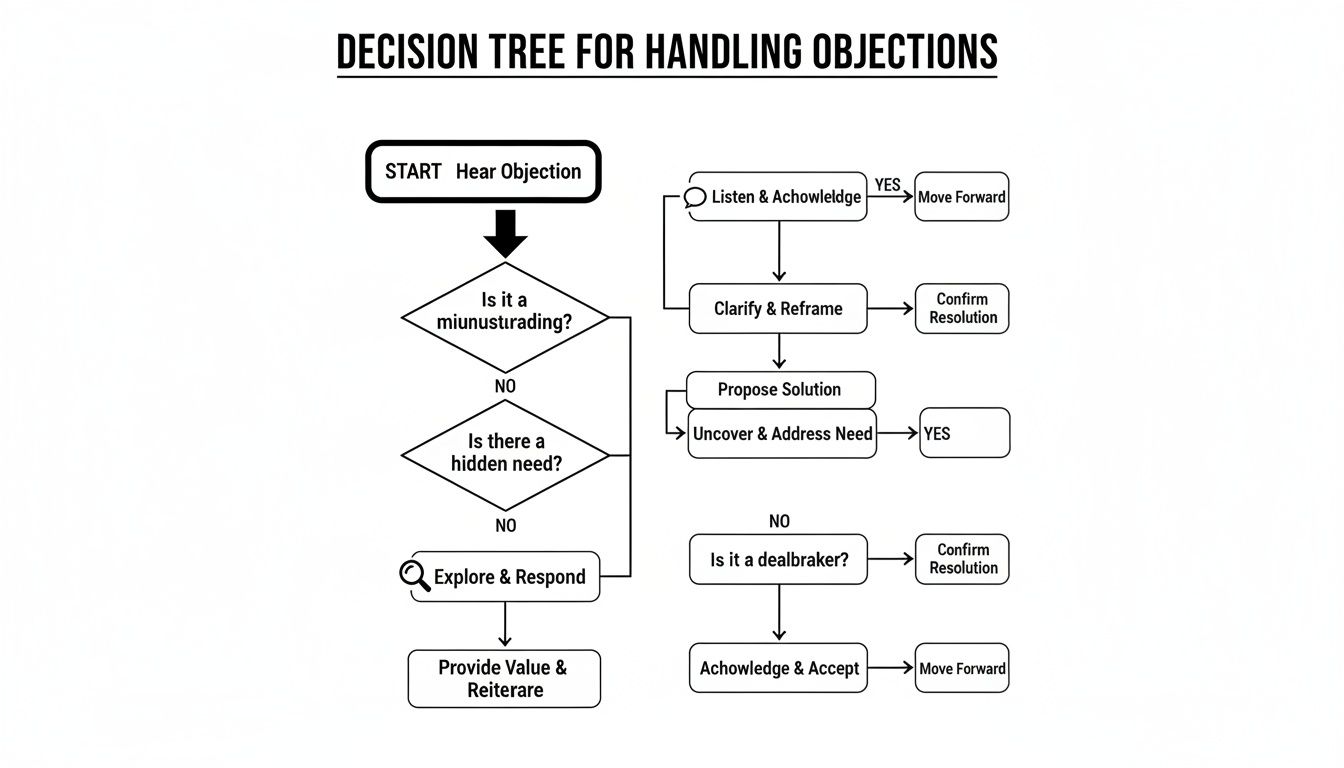
This visual is a great reminder that your response is useless until you truly understand the real concern hiding behind their words.
Tackling the Price Objection: "It's Not in the Budget"
This is the classic. But let's be honest, it's rarely about the sticker price. It's almost always a value problem. Your job is to pivot the conversation away from cost and toward investment and tangible outcomes.
Strategy 1: Isolate the Variable
Before you do anything else, you need to find out if price is the only thing standing in the way.
- Try this: "I appreciate you being upfront about the budget. Let's put price aside for just a second. If the numbers worked out perfectly, is our solution the one you'd want to solve [their specific problem]?"
This question is a game-changer. It forces them to show their hand. If they say "yes," you've successfully isolated the price objection and can now focus all your energy on building a rock-solid value case.
Strategy 2: Reframe to ROI
You need to connect the dots between what they pay and what they get. Talk about their business, not your product.
- Try this: "That’s a fair point, and a few of our best clients felt the same way at first. What they found, though, was that by solving [problem], they saved X hours a week, which put over $Y back into their budget in the first year alone. Can we map out what a similar impact might look like for you?"
Handling the Competitor Objection: "We're Happy with Competitor X"
Hearing this is actually good news! It means they’ve already bought into the idea of a solution like yours. The goal here isn't to sling mud at the competition. It's to gently find the cracks in their current setup and shine a light on what makes you different.
Dislodging an incumbent is a delicate dance. You have to start by digging into their world without making them feel defensive. The right questions are everything. For some great examples, check out our guide on mastering discovery questions in sales.
An objection isn't a dead end; it's a detour. The prospect is telling you the exact route you need to take to win their trust. Your job is to listen to the directions.
Strategy 1: The 'Curiosity' Angle
Acknowledge their current provider and then get curious.
- Try this: "That's great to hear. We know [Competitor X]; they're a solid company. Just out of curiosity, what do you like most about working with them? And if you could wave a magic wand and change just one thing about their platform, what would it be?"
This opens the door to uncovering pain points they might not even realize they have until you ask.
Defusing the Timing Objection: "Call Me Next Quarter"
This is the polite "no for now." Your job is to create a sense of urgency by highlighting the cost of doing nothing. What pain are they agreeing to live with for the next 90 days?
Strategy 1: Quantify the Delay
Put a number on what it costs them to wait.
- Try this: "I can definitely do that. Just so I can come prepared for our next chat, you mentioned the team is losing about 10 hours a week on manual reporting right now. Over the next quarter, that's around 120 hours of lost productivity. When we reconnect, what would be a good outcome for you regarding that time?"
Suddenly, the delay isn't a passive wait; it's an active loss. This simple math often gets them to rethink their timeline. In today's economy, where buyers are 78% more careful with spending, showing this "cost of inaction" is crucial.
Navigating the Authority Objection: "I'm Not the Decision-Maker"
Perfect. This is your chance to turn your contact into an internal champion who sells for you. The key is to empower them, not try to go around them.
Strategy 1: The 'Enablement' Play
Offer to do the heavy lifting to make them look good.
- Try this: "No problem at all, and thanks for letting me know. To make it super easy for you to share this with your [decision-maker's title], what are the one or two key outcomes you think would really get their attention? I can put together a quick, one-page summary focused specifically on that."
This approach shows respect, makes their job easier, and ensures your core value prop gets to the right person, framed in the right way.
How to Systematize Objection Handling with a CRM

Great objection handling isn't just about having a few sharp reps. It’s a team-wide advantage you can build and scale. When you leave it up to individual reps to figure it out on their own, you get inconsistency. Reinventing the wheel on every call is a massive time-sink.
A much better way is to build a system, and your CRM is the perfect tool for the job. This approach transforms your CRM from a simple digital rolodex into an intelligence engine that turns scattered insights into a playbook everyone can use to win more deals. You’ll stop just reacting to roadblocks and start proactively paving the way for smoother sales cycles.
Log Every Objection with Custom Properties
It all starts with disciplined data collection. You can't fix what you can't see.
The first move is to create a custom property in your CRM for logging objections. Make it a mandatory field to complete after every sales call. A simple dropdown menu is way more effective than an open text box because it keeps the data clean and consistent.
You don't need to overcomplicate it. Just capture the essentials:
- Objection Category: (e.g., Price, Timeline, Competitor, Need)
- Objection Sub-Type: (e.g., "Not in budget," "Happy with Competitor X")
- Resolution Status: (e.g., Resolved, Escalated, Lost)
This simple habit creates an absolute goldmine of data. In just one quarter, you can pull reports to see exactly which hurdles are costing you the most deals. It answers the big questions, like, "What were the top three roadblocks our team faced this month?"
By systematizing how you overcome objections in sales, you turn gut feelings into hard data. It’s the difference between guessing what your market is thinking and knowing for sure.
Turn Data into Actionable Sales Plays
Once you have that data, you can stop playing defense and start building a real strategy. The insights from your CRM become the foundation for resources that you can store right inside the platform, ready for your whole team to use.
For example, let's say "Competitor X" keeps popping up. Instead of just winging it, you build a dedicated playbook.
- Create a Competitor Battlecard: This is a one-page document you store in your CRM that gives your reps the quick-and-dirty on their strengths, weaknesses, and exactly how you stack up.
- Develop Email Templates: Pre-written follow-up emails that tackle common concerns about that competitor, maybe with a powerful case study already attached.
- Draft Talk Tracks: Proven scripts and talking points your reps can pull up live on a call to navigate the conversation with confidence.
Making this a core part of your process is key. If you need a hand with the setup, our guide on how to implement a CRM system effectively can walk you through it.
Automate Nurture Sequences and Follow-Ups
The B2B buying journey has changed. Over 75% of B2B buyers and sellers now prefer digital self-serve options and remote chats. With buying committees averaging 6 to 10 stakeholders, you have to be smarter and more automated in how you engage.
This is where you put your CRM's automation power to work, addressing common objections before they even have a chance to stall a deal.
- Price Objection Nurture: A prospect gets sticker shock and goes cold? Your CRM can automatically enroll them in a 3-part email sequence that shows off ROI, shares testimonials, and sends a case study from a similar company that saw huge value.
- Timeline Objection Follow-Up: For those "call me next quarter" folks, you can set an automatic task and email reminder for the rep. At the same time, the CRM can add the contact to a low-touch nurture stream that shares useful content, keeping you top-of-mind without being pushy.
This kind of system ensures no opportunity slips through the cracks. It turns every objection into a learning moment, constantly refining your sales process and equipping your entire team to overcome objections in sales more effectively.
Common Questions About Overcoming Objections
Even with the best playbook in hand, sales calls have a way of throwing you curveballs. Learning how to handle objections isn't something you master overnight; it’s a constant process of listening, learning, and tweaking your approach.
Here are some of the most common questions I hear from reps trying to put these ideas into practice.
What If an Objection Is Just a Hard No?
This is a big one. Sometimes, a "no" really is just a "no." Knowing when to push and when to politely walk away is a skill that separates good reps from great ones.
Persistence is all about adding value and solving real problems, not about strong-arming someone who has clearly made up their mind. If a prospect keeps repeating the same objection after you’ve tried to explore it from a few different angles, or if their tone just feels final, it’s time to read the room. Respect their decision.
The goal here is to be a trusted advisor, not an opponent. A good final check is to offer one last piece of value, no strings attached. You could say something like, "I get it, seems like the timing isn't right. Would it be helpful if I sent over a guide on [a related topic] for your team? No pressure at all." This ends the conversation gracefully and keeps the relationship intact for the future.
Pushing past a firm "no" doesn't just lose you the deal—it torches the bridge. Knowing when to stop is just as crucial as knowing how to persist.
How Do You Train New Reps on These Techniques?
You can't just hand a new hire a script and expect them to handle objections well. It’s all about building their conversational muscle memory through practice, feedback, and more practice.
- Start with the 'Why': First, walk them through the core ideas—the four main types of objections and the frameworks like LAER or Feel-Felt-Found. They need to understand the psychology behind it, not just memorize lines.
- Role-Play Until It's Second Nature: This part is non-negotiable. Set up regular, recorded role-playing sessions. Have them practice against seasoned reps who can throw real-world objections at them—the same ones you see logged in your CRM.
- Let Them Shadow the Pros: Get new reps to listen in on live calls with your top performers. This is where they hear how the frameworks sound in a real, unscripted conversation. It’s totally different from a sterile training environment.
- Coach from Call Recordings: Use tools like Gong or Chorus.ai to review their calls. Pinpoint the exact moments where they nailed an objection or where a different tactic might have worked better. This specific, targeted feedback is gold.
This combination takes them from just knowing the material to feeling confident enough to handle the pressure when they're live with a prospect.
Should You Adapt Your Approach for Different Buyers?
Absolutely, 100%. Using a one-size-fits-all rebuttal is a recipe for failure. The way you handle an objection from a numbers-driven CFO is completely different from how you’d talk to a big-picture CEO. You have to speak their language.
Think about it this way: a CFO objects to the price. Your response needs to be all about the numbers. Talk about ROI, total cost of ownership (TCO), and the payback period. Give them hard data they can plug into a spreadsheet.
But if you get a concern from a Head of Marketing about how complicated the software is to implement, you need a different angle. You should focus on ease of use, team adoption, and the hands-on support you provide. Share case studies and testimonials from other marketing leaders who had a smooth rollout.
When you tailor your response to the buyer's role and what keeps them up at night, your argument becomes way more compelling.