A 30-60-90 day sales plan is a new hire's roadmap for their first three months on the job. It breaks down the overwhelming task of starting a new role into three distinct, manageable phases: learning, doing, and refining. The goal is to get a new rep aligned with the company's way of doing things and contributing to the pipeline as quickly as possible.
Why a Sales Plan Is Your B2B Team’s Secret Weapon
Let’s be honest: starting a new B2B sales role can feel like drinking from a firehose. You've got long sales cycles, complex products, and high-stakes deals to navigate. The pressure is on from day one.
Without a clear plan, new hires often just spin their wheels, which leads to longer ramp-up times and, frankly, lost revenue. This is exactly where a 30-60-90 day sales plan becomes less of a nice-to-have and more of a must-have.
It gives new Account Executives, SDRs, and even managers a clear path forward. Instead of guessing what to prioritize, they have a playbook for learning the product, understanding the customer, and getting up to speed with the team.
Setting the Stage for Early Wins
The biggest win here is creating a clear, intentional path to productivity. It helps new team members focus their energy on the right activities at the right time.
- Faster Onboarding: It turns the initial chaos into a series of achievable milestones.
- Clear Expectations: The plan gets the new hire and their manager on the same page from the get-go, avoiding frustration and misunderstandings.
- Built-in Accountability: With measurable goals for each phase, both the rep and their manager can easily track progress and pinpoint where extra support might be needed.
This timeline gives you a good visual of how a new rep progresses from learning the ropes to building a pipeline and eventually hitting their number.
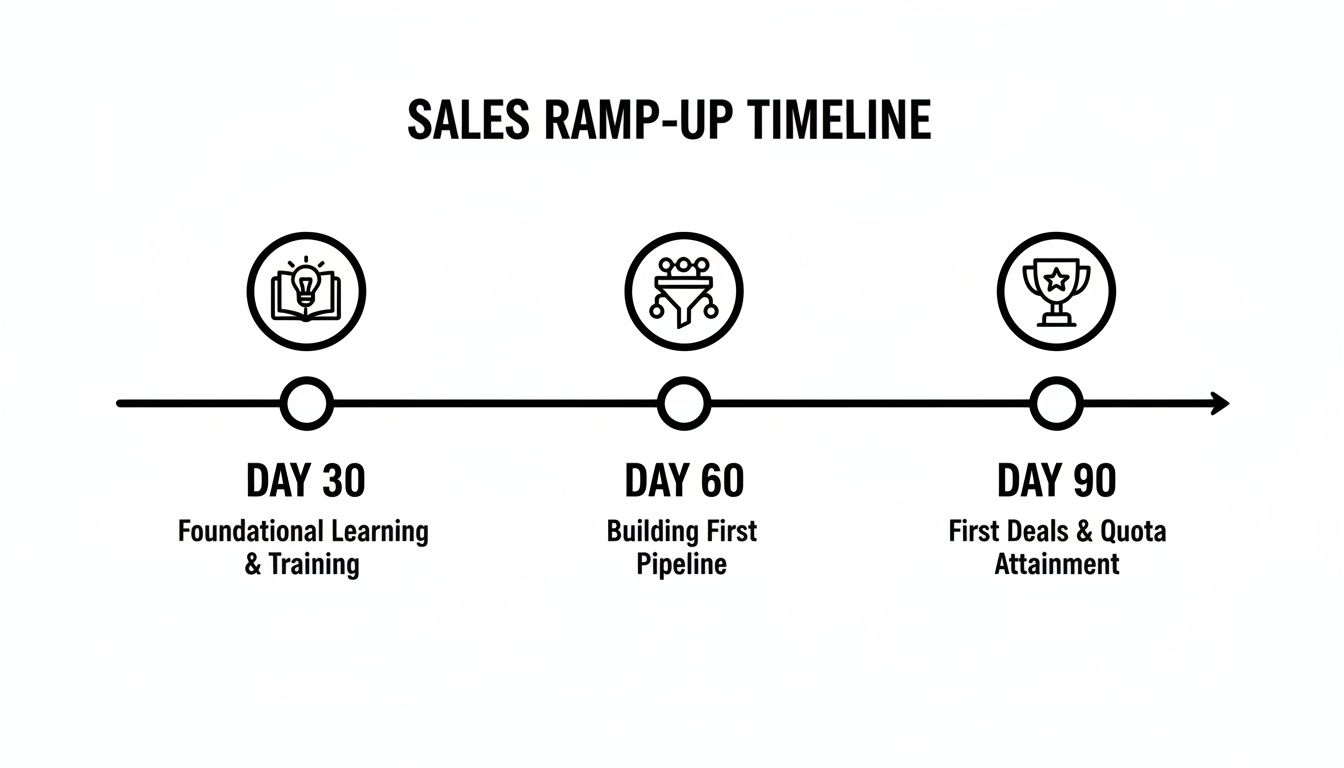
As you can see, it's a systematic build. Each phase lays the foundation for the next, building both confidence and capability over 90 days.
The Impact on Performance
In a tough B2B market—especially when you're selling something complex like a CRM—a solid 30-60-90 day sales plan can make a world of difference in how fast someone ramps.
Data from sales enablement experts shows that reps who follow a structured plan can hit 25-50% of their quota by day 30, get to 75% by day 60, and reach full productivity by the end of the 90 days. Compare that to the six to nine months it can take without a plan. You can dig into more insights on effective sales ramp plans to see just how big the impact is.
A great 30-60-90 day sales plan does more than just onboard a new hire; it instills a sense of purpose and direction, showing them exactly how they contribute to the company's larger mission from day one.
At the end of the day, this plan is an investment in your team's long-term success. It ensures every new person on the sales floor has a clear strategy to start delivering results fast.
Days 1-30: Mastering the Fundamentals
The first 30 days in a new B2B sales role are not about closing deals. I know, that's a tough pill to swallow for any driven salesperson, but the real mission here is total immersion. Your goal is to build the unshakeable foundation you'll need to absolutely crush it later on.
Think of yourself as a detective for the first month. Your job is to absorb everything you can about the company’s product, its customers, the sales process, and the people who make it all happen. This initial phase of your 30-60-90 day sales plan is all about learning, not earning.

This means your Key Performance Indicators (KPIs) won't have a dollar sign in front of them. Instead, you'll be measured by your proactive effort to learn and connect. Success looks like scheduling internal meetings, acing product training, and deeply researching your target accounts in the CRM.
Your Primary Learning Objectives
During this first month, your main goal is to become a credible internal resource. You simply can't sell what you don't understand, and you can't get deals done if you don't know who to pull in for help.
Here’s what to zero in on:
- Become Product Fluent: Go way beyond memorizing features. Your aim is to truly understand the real-world problems your product solves for actual customers.
- Deeply Understand the Ideal Customer Profile (ICP): Get inside the heads of your best customers. Learn their industries, their biggest headaches, and what finally pushes them to look for a solution like yours.
- Master the Sales Process and Tools: Get comfortable with the company’s sales methodology and tech stack, especially the B2B CRM. You should know every stage of the pipeline and exactly what defines a qualified opportunity.
- Build Your Internal Network: Start identifying and connecting with key players in other departments. These relationships in marketing, customer success, and product will be your secret weapon down the line.
Focusing on these areas builds genuine confidence and competence. When you finally do start reaching out to prospects, you'll be operating from a position of strength and knowledge, not just reading from a script.
Structuring Your First 30 Days
To make this learning phase count, you need a concrete plan. A vague goal like "learn the product" won't cut it. You need to break it down into specific, measurable tasks you can actually check off a list.
Here’s a practical checklist to get you started:
- Knock Out All Formal Onboarding: Get all the required HR paperwork, systems training, and any product certification courses done and dusted. This stuff is non-negotiable.
- Schedule 1:1 Meetings: Be proactive. Set up intro calls with at least two people from marketing, two from customer success, and one from the product team. Ask them what their biggest challenges are and how sales can be a better partner.
- Shadow the Top Performers: Sit in on at least five discovery calls and three product demos with the veteran reps. Take detailed notes on not just what they say, but how they say it and the brilliant questions they ask.
- Dig into Past Deals in the CRM: Go back in time. Review the history of five closed-won and five closed-lost deals. Look at the call logs, the timeline, and who was involved to spot patterns of success and failure.
The fastest way to understand your territory isn't by looking at a list of accounts. It's by studying the history of deals within that territory to see what worked, what didn't, and why.
This hands-on approach gives you context that no training manual ever could. You’ll start to pick up on the subtle nuances of your market and see how the product actually works in the wild.
Measuring Success in Month One
Without a quota hanging over your head, how do you and your manager track your progress? You lean on activity-based and knowledge-based metrics. This keeps you accountable and shows you're making the most of this critical ramp-up period.
Here’s a simple table to help structure your focus areas and the KPIs you can use to measure them in the first 30 days.
Phase 1 (Days 1-30) Focus Areas and KPIs
| Focus Area | Key Activities | Example KPIs |
|---|---|---|
| Product & Market Knowledge | Complete certifications, study competitor websites, review marketing personas. | 100% completion of training modules; create a one-page summary of two main competitors. |
| Internal Processes & Tools | Master CRM basics, learn the lead routing rules, understand the deal stages. | Successfully log 10 test activities in the CRM; map out the sales cycle from lead to close. |
| Team & Company Integration | Meet with key contacts in marketing, customer success, and product. | Hold a minimum of 10 internal introductory meetings; attend all scheduled team huddles. |
| Territory & Account Planning | Research your top 20 target accounts, identify key contacts on LinkedIn. | Build a target account list in the CRM with at least three contacts per account. |
These KPIs are tangible and prove you're building the necessary muscle for what comes next.
By the end of day 30, you should feel fully integrated into the team with a clear map of the landscape. You'll be ready to stop absorbing knowledge and start putting it into action.
Days 31-60: Turning Knowledge into Action
Alright, you’ve spent a solid month soaking everything up. Now, the second phase of your 30-60-90 day sales plan is where the rubber really meets the road. It's time to stop just learning and start doing.
This 30-day stretch is all about execution. You're taking all that product knowledge and market insight you've gathered and translating it into real sales activities. Your focus shifts from internal meetings and training to external conversations and building a healthy pipeline. Success isn't measured by what you know anymore—it's about what you do with it. This is when you start to make a real impact.
Setting Action-Oriented Goals
In this middle phase, your goals need to be less about learning and more about producing. You're not just shadowing calls; you're leading them. The whole point is to build momentum and start filling your pipeline with qualified opportunities you can track in your B2B CRM.
Your primary goals should be crystal clear and measurable. Think along these lines:
- Generate Pipeline Value: Aim to create a specific amount of new pipeline, say $50,000, in qualified opportunities.
- Book Qualified Meetings: Set a hard target for discovery calls with actual decision-makers. Maybe that's 10-15 meetings for the month.
- Achieve Activity Metrics: Hit your daily or weekly activity numbers consistently. This could be 40 calls and 60 personalized emails a day.
These kinds of goals give you a clear benchmark for your own performance and provide your manager with real data to coach you effectively.
Executing Your First Sales Activities
Let's talk about the day-to-day grind. The key here is to be methodical and, above all, personal. Blasting out generic emails just doesn't cut it in B2B sales. You have to show prospects you’ve actually done your homework.
A typical week should have a good rhythm:
- Prospecting and Research: Block out time on your calendar specifically for this. Dig into LinkedIn Sales Navigator and your own CRM to find the right people at your target accounts and uncover what they care about right now.
- Personalized Outreach: Build a multi-touch cadence that isn’t just a series of emails. Mix in calls and social media engagement. A quick note referencing a recent company announcement or a post they shared can make all the difference.
- Conducting Discovery Calls: This is your moment. Use what you learned from shadowing the top reps to ask smart, open-ended questions that get to the heart of a prospect's business challenges. Our guide on how to qualify B2B leads offers a great framework for these make-or-break conversations.
It's always quality over quantity. Ten well-researched, thoughtful outreach attempts will beat 100 generic email blasts every single time.
The Crucial Role of Managerial Coaching
This is also the phase where feedback from your manager is absolutely essential. They should be your strategic partner, helping you fine-tune your messaging and tactics based on what’s happening in the real world.
Regular call reviews and pipeline check-ins aren't micromanagement. They are vital coaching opportunities that help a new rep build the right habits from day one and ramp up faster.
For example, your manager might listen to a call recording with you and offer specific pointers: "You built great rapport at the start, but next time, try asking 'why' one more time when the prospect mentions budget. That’s how you dig down to the root of the problem." That kind of targeted advice is gold.
This structured approach flat-out works. Sales teams are 57% more likely to smash their annual targets when their plans include sales intelligence frameworks. Another analysis found new reps using these phased plans improved their pipeline hygiene by 40%, creating an average of $250K in pipeline per rep by day 60. You can dig into the full research on these sales intelligence planning findings to get more context.
Tracking Progress and Optimizing in Your CRM
Your CRM is your command center during these 30 days. It’s where you’ll live—tracking every activity, managing your pipeline, and measuring how you’re doing against your goals.
Get comfortable using your CRM's best features:
- Kanban Pipeline View: Get a visual snapshot of your opportunities as they move through the sales stages. It’s the fastest way for you and your manager to spot any deals that are getting stuck.
- Task Automation: Set up automated reminders for every follow-up. Don't let a single lead fall through the cracks because you forgot to reach out.
- Email Templates and Sequences: Use the pre-approved templates as a starting point, but always, always personalize the first few sentences for each and every prospect.
By the time you hit day 60, you should have a budding pipeline, a good sense of what outreach is working (and what isn't), and a solid weekly routine. You'll have officially transitioned from a student of the business to an active, contributing member of the team.
Days 61-90: Driving Results and Owning Your Role
Alright, you've made it through the first two months. By now, you're past the "new kid on the block" phase. The first 60 days were all about soaking up knowledge and putting it into practice. This final month is where the rubber really meets the road. It's time to drive consistent results and become a fully autonomous, strategic part of the sales team.
Think of this as the optimization phase. You’re not just following the playbook anymore; you're finding ways to make it better. The real goal here is to shift from just doing your job to truly owning your territory, navigating those tricky, multi-threaded deals, and making a real impact on the team's bottom line.

Shifting to Outcome-Based Goals
Up until now, your metrics were probably focused on activity—how many calls you made, how many emails you sent. Now, the focus shifts to what those activities actually produced. Success is now measured in revenue, forecast accuracy, and the overall health of your pipeline.
Here’s what you should be aiming for in this final stretch:
- Hit a Real Quota Percentage: This is the big one. Your target should be to close at least 75% of a fully ramped sales quota. It proves you can deliver.
- Nail Your Forecast Accuracy: Aim for 90% accuracy when you call your shot. This shows you have a deep understanding of your pipeline and builds serious trust with leadership.
- Boost Your Win Rate: Look back at your last month. Where did you win? Where did you lose? Pick one or two areas and focus on improving your conversion rates.
Hitting these goals proves you can do more than just build a pipeline—you can manage it all the way to a closed-won deal. For a deeper look at what to track, check out our guide on essential sales performance metrics examples.
Stepping Up to Advanced Sales Activities
With a healthy pipeline humming along, your day-to-day work naturally gets more complex. You're no longer handling one or two opportunities; you're juggling multiple deals at different stages, each with its own unique challenges. This is where your skills are truly put to the test.
Here's what you'll be doing:
- Navigating Tough Negotiations: You’ll be leading the charge on conversations about pricing, contract terms, and implementation. This requires knowing your product’s value inside and out and having the confidence to stand firm.
- Managing Multiple Stakeholders: Let's be real, B2B deals are rarely simple. You'll need to get buy-in from the person with the budget, the end-user, and the tech team—and they all have different priorities.
- Bringing Strategic Insights to the Table: In team meetings, you’re now expected to do more than just read off your numbers. You should be sharing what you're hearing on the ground, like a new competitor tactic or a common objection that keeps popping up.
This evolution is a key part of any solid 30-60-90 day plan for a B2B team. For small and mid-sized businesses, this is critical. KPIs shift from just learning the ropes to hitting 75% quota attainment and 90% forecast accuracy. Getting this right can boost a rep’s productivity by an incredible 50% in their first quarter. SPOTIO actually has some great data on this for field sales teams.
The ultimate goal of days 61-90 is to transition from being a rep who needs guidance to one who provides value. You're not just closing deals; you're becoming a trusted advisor to your clients and a valuable resource for your team.
Making Your B2B CRM Your Secret Weapon
To hit these more advanced goals, you have to work smarter. Your B2B CRM isn't just a place to log calls anymore; it’s your command center for analysis and optimization.
Think of it as your personal performance dashboard. If you dig into the data, you can spot your own bottlenecks before your manager does and start fixing them.
Here's how to put your CRM to work for you:
- Dive Into Your Dashboards: Look at your conversion rates between pipeline stages. Where are deals getting stuck? If you see a lot of opportunities stalling after the demo, it might be a sign you need to tighten up your presentation or get more creative with your follow-up.
- Team Up with Marketing: Use the data you’re gathering to help out the marketing team. If you keep hearing about a specific competitor or a missing feature, that's pure gold for them. It helps them create more targeted content that actually helps you sell.
- Refine Your Outreach: Take a hard look at your email sequences. Which ones are getting opens and replies? Kill the ones that aren't working and double down on what is. A small tweak can make a huge difference.
By the end of day 90, you should be a fully productive, strategic, and self-sufficient member of the sales team. Your ramp-up is complete. Now, you’re a consistent contributor to the company's bottom line.
Different Plans for Different Players: Tailoring Your 30-60-90 Day Plan
A generic 30-60-90 day plan is a bit like a one-size-fits-all t-shirt—it gets the job done, but it never really fits anyone perfectly. In a modern B2B sales org, every role has a distinct mission. What success looks like for an Account Executive is worlds away from the daily grind of an SDR or the strategic view of a new Sales Manager.
If you want this plan to be more than just a piece of paper, you have to tailor it to the specific job. An AE’s roadmap is all about building pipeline and bringing in revenue. An SDR's world revolves around one thing: booking high-quality meetings. And a new manager? Their focus is on understanding the team and making the whole machine run better.
The Account Executive Plan: All About Revenue
For an Account Executive (AE), the 30-60-90 day plan is their personal roadmap to hitting quota. Simple as that. The first month is still about getting their bearings, but the clock is already ticking to build a pipeline and start closing. Their success is measured in dollars and deals.
-
Days 1-30: Learn the Ropes and Map the Territory. The first month is a deep dive. AEs need to master the product’s value proposition for their specific patch and get forensic on their territory. This means digging into the CRM, analyzing past wins and losses, and flagging the top 20 high-potential accounts to hit first.
-
Days 31-60: Get in the Game and Build Pipeline. This is where the real action starts. The goal shifts to actively creating qualified pipeline, ideally aiming for 1.5x to 2x their quarterly quota in new opportunities. They'll be running their own discovery calls, leading demos, and working to build relationships across multiple levels of their target accounts.
-
Days 61-90: Close Deals and Call Your Shot. The final stretch is all about getting deals over the line. The AE should be comfortable handling tough negotiations, managing objections, and, crucially, forecasting their numbers with confidence. A huge milestone here is closing their first real deal and hitting at least 75% of a fully ramped quota.
The SDR Plan: Laser-Focused on Qualified Meetings
The Sales Development Representative (SDR) is the engine room of the sales floor. They’re tasked with sparking the initial conversations that AEs turn into revenue. Because of this, their plan isn’t about closing deals—it’s about mastering outreach and booking solid meetings.
An SDR's success is defined by their ability to consistently generate high-quality conversations. Their 90-day plan must be a masterclass in effective prospecting and communication.
Their plan has to reflect that sharp focus:
-
Days 1-30: Master the Message. Before they pick up the phone, an SDR needs to become an expert on the ideal customer profile (ICP). They have to learn the outreach cadences and scripts until they're second nature. Success here isn’t about meetings booked; it's about acing certifications and booking 3-5 internal mock discovery calls that get a thumbs-up from a manager or senior AE.
-
Days 31-60: Go Live and Execute. Now, it’s game time. The SDR starts running multi-channel outreach—email, calls, LinkedIn—with a clear activity goal, often around 80-100 touchpoints a day. The key metric that matters? Booking 8-10 qualified meetings that AEs actually accept and run with.
-
Days 61-90: Optimize and Beat the Target. By the third month, it’s about moving from competence to excellence. The SDR should be looking at their own data—what subject lines work? what call scripts get responses?—to refine their approach. The goal is no longer just to hit quota, but to consistently blow past it.
The Sales Manager Plan: It’s All About the Team
When a new Sales Manager steps in, their 30-60-90 day plan looks completely different. It has nothing to do with their own sales numbers and everything to do with elevating their team. Their first 90 days are a whirlwind of listening, diagnosing, and implementing changes to make everyone more successful.
This plan is strategic, and it’s about people. If you're stepping into this role, our guide on how to manage a sales team offers a much deeper look into what it takes to succeed from day one.
Here’s a snapshot of a manager’s first 90 days:
| Phase | Primary Focus | Key Activities & Goals |
|---|---|---|
| Days 1-30 | Learn and Assess | Sit down for 1:1s with every single rep. Live in the sales dashboards. Shadow calls. Truly understand the current sales process from lead to close. |
| Days 31-60 | Diagnose and Strategize | Pinpoint the 2-3 biggest bottlenecks in the sales funnel. Review the tech stack to find inefficiencies. Start drafting a specific coaching plan for each rep. |
| Days 61-90 | Implement and Coach | Roll out one meaningful process improvement. Establish a consistent team coaching rhythm. Set and communicate clear, updated KPIs for the entire team. |
By customizing the plan for the person and the position, you give every new hire a clear, relevant, and actionable path forward. It’s the single best way to set them up for a strong start and long-term success.
Your 30-60-90 Day Sales Plan Questions, Answered
Okay, so you've got a template and a solid draft of your 30-60-90 day sales plan. That’s the easy part. The real test comes when you have to present it, execute it, and avoid the common traps that trip people up.
Let's dig into the questions I hear all the time. Getting these details right is what separates a plan that collects dust from one that actually launches your success.
How Should I Present This Plan in a Sales Interview?
Walking into an interview with a 30-60-90 day plan is a massive power move, but your delivery is everything. Don't just slide a document across the table. Think of it as a mini-presentation that proves you’re a strategic thinker who’s already invested in their success.
Here's how to nail it:
- Keep it brief and punchy. Give them the highlights. Start with something like, "My first 30 days are all about total immersion—learning the product, the playbook, and the people."
- Weave in your research. Show you’ve done your homework. Mention something specific like, "I saw on your site that you're making a big push into the healthcare vertical. My 60-day phase is focused on building a targeted list of hospital administrators to start conversations there."
- Position it as a starting point. You're not dictating terms; you're showing initiative. Wrap it up by saying, "This is my initial roadmap based on what I could see from the outside. I'm really looking forward to getting my manager's input to make sure I'm hitting the ground running on day one."
This approach screams confidence, preparation, and coachability—exactly what hiring managers want to see.
What Are the Biggest Mistakes to Avoid?
It's surprisingly easy to get this wrong. The most common pitfall is a plan that's either so vague it's useless or so ambitious it's pure fantasy. You have to strike that perfect balance between pushing yourself and being realistic.
The biggest mistake is treating your 30-60-90 day sales plan as a static checklist. It should be a living document—a strategic guide that you and your manager adapt as you learn more about the role and the market in real time.
A few other classic blunders to dodge:
- Skipping the learning curve. Eagerly jumping into "making sales" without first planning to master the product, ideal customer profile, and sales process is a recipe for disaster.
- Being painfully generic. A goal like "generate leads" means nothing. A goal like "book 10 qualified discovery calls with VPs of Operations in my target accounts" is a real, measurable objective.
- Going it alone. Don’t build your plan in a vacuum. Your manager has the tribal knowledge and context you desperately need to set goals that actually make sense for the business.
How Often Should My Manager and I Review This?
This plan shouldn't be a "set it and forget it" document. Think of it as your roadmap for ongoing coaching and staying aligned with your manager.
The best cadence I’ve seen is a dedicated weekly check-in. This isn't just another pipeline review; it's a specific, protected time to look at the plan together.
In these meetings, you can track progress, talk through roadblocks, and adjust on the fly. Maybe the cold-calling script isn't landing as you'd hoped. Great—use this meeting to brainstorm a new angle with your manager. This transforms the plan from a piece of paper into a dynamic tool for ramping up fast.