Think of B2B marketing automation as your marketing team's secret weapon. It’s the software that handles all those repetitive, but crucial, marketing tasks so your team doesn't have to. It works behind the scenes, nurturing leads through what are often very long sales cycles.
Essentially, it acts like a digital assistant. It can send personalized emails, keep track of which leads are most interested by "scoring" their activity, and even give your sales team a nudge when a prospect is warm enough for a real conversation. The whole point is to make the journey from a first click to a closed deal as smooth and efficient as possible.
What Is B2B Marketing Automation, Really?

Before we get into the nitty-gritty of workflows and integrations, let's break down what B2B marketing automation actually does day-to-day. Picture it as your team’s most reliable employee—one that works 24/7 to manage the essential but time-sucking activities. This "assistant" makes sure no lead ever falls through the cracks and that every touchpoint feels timely and relevant.
But this technology is so much more than a glorified email blaster. It's a smart system built to understand and react to customer behavior. For example, when someone downloads a whitepaper from your website, the platform can automatically trigger a follow-up email a few days later offering a related case study. This ability to respond to user actions in real time is what really sets automation apart from old-school, manual marketing.
The Core Purpose Behind the Technology
At its heart, B2B marketing automation was built to solve the unique headaches of the business-to-business world. Marketing to another business isn't like selling a pair of shoes to a single consumer (B2C), where purchases can be quick and emotional. B2B sales are a completely different ballgame.
The B2B buying journey is almost always defined by:
- Longer Sales Cycles: Decisions can drag on for months, sometimes even years. Automation helps you stay top-of-mind without annoying people.
- Multiple Decision-Makers: You're rarely selling to just one person. A purchase often needs a green light from a whole committee of people, each with their own concerns.
- High-Value Relationships: B2B deals involve big money. That means trust and relationship-building aren't just nice-to-haves; they're absolutely critical to closing the deal.
Automation helps you manage this complexity. It gives you a structured way to engage with everyone on the buying committee, sending them content that actually speaks to their specific role and problems over that long sales cycle.
B2B marketing automation bridges the gap between marketing's broad outreach and sales' focused conversations. It systematically warms up potential customers, ensuring that by the time a salesperson gets involved, the lead is educated, engaged, and genuinely interested.
To better understand how these systems deliver value, let's look at their main jobs.
Core Functions of B2B Marketing Automation
| Core Function | Primary Business Benefit |
|---|---|
| Lead Nurturing | Builds relationships and trust with prospects over time by delivering relevant content automatically. |
| Lead Scoring | Prioritizes leads for the sales team by identifying who is most engaged and ready to buy. |
| Email Marketing | Sends personalized, targeted email campaigns based on user behavior and segmentation. |
| Account-Based Marketing (ABM) | Focuses marketing and sales resources on a set of high-value target accounts. |
| Analytics & Reporting | Measures campaign effectiveness and demonstrates marketing's direct impact on revenue (ROI). |
These functions work together to create a powerful engine for growth, turning cold traffic into qualified opportunities.
How It Functions Day to Day
So, what does this actually look like in practice? A B2B marketing automation platform pulls the strings on a series of tasks that would be a nightmare to manage by hand, especially as you grow. It becomes the central hub for all your lead generation and nurturing efforts.
Let's walk through a typical scenario. A new prospect fills out a form on your website. The moment they hit "submit," the automation software kicks into gear:
- Lead Scoring: It instantly assigns points based on who they are (e.g., "Director" title at a 500+ employee company) and what they did (e.g., visited the pricing page).
- Segmentation: The software sorts the new lead into a specific list—maybe "Manufacturing Industry" or "Interested in Product X"—for more tailored communication.
- Nurturing Workflows: It enrolls them in a pre-built email series designed to educate them on how you solve their specific problems.
- Sales Alerts: Once the lead's score hits a certain threshold, the system automatically sends a notification to the right salesperson, signaling that this person is hot and ready for a call.
Ultimately, this entire process transforms raw, top-of-funnel interest into genuine, sales-qualified opportunities with incredible precision. It frees up your team to focus on bigger-picture strategy and building real human connections, leaving the grunt work to the software.
The Pillars of a Powerful Automation Strategy
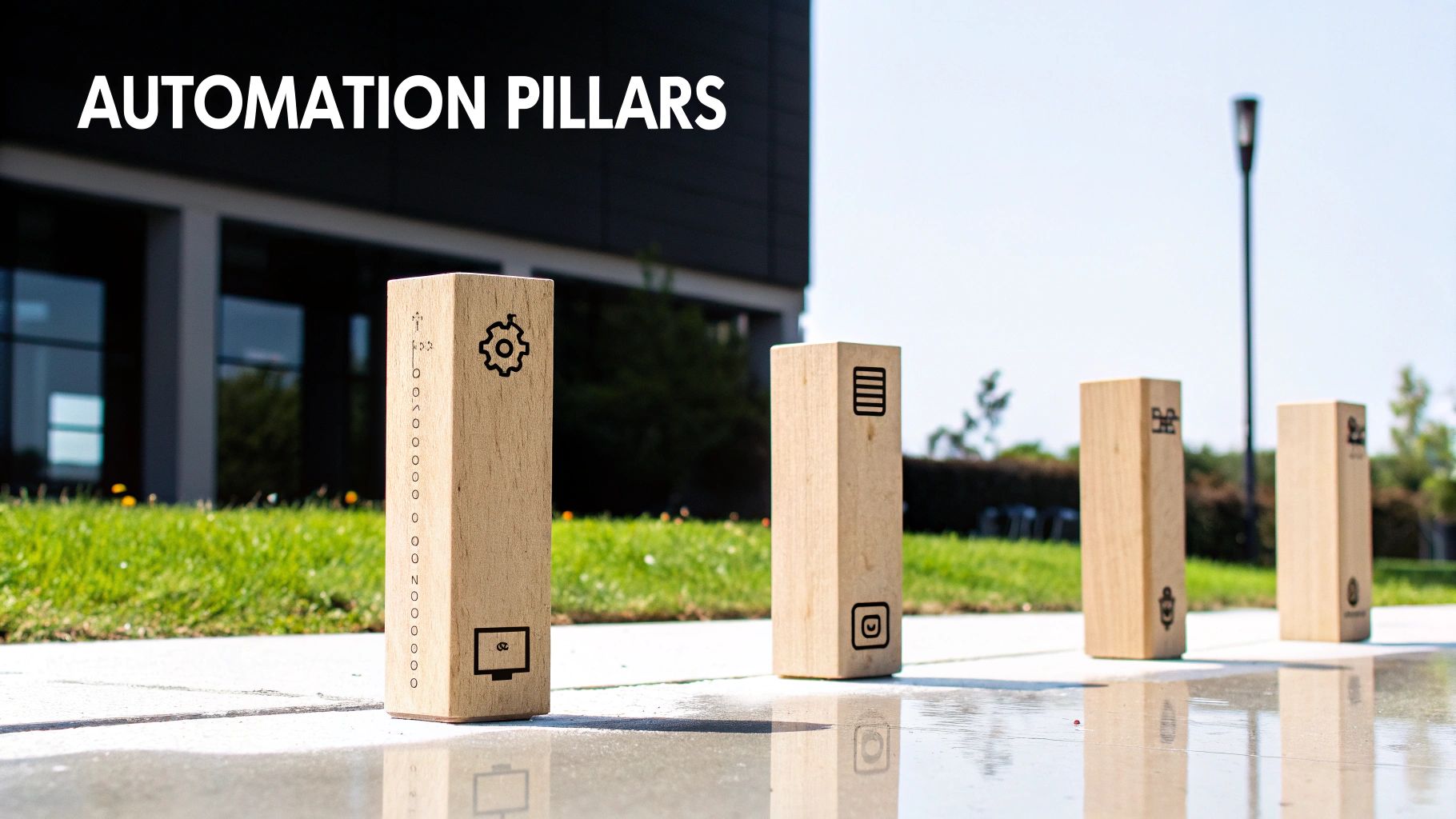
A great B2B marketing automation strategy isn't just about the software you buy; it's about the framework you build with it. Without a solid plan, even the most advanced tools create more chaos than clarity. Think of it like building a house—you need strong pillars to hold everything up.
These pillars provide the structure to navigate long B2B sales cycles, turning vague interest into real, qualified sales opportunities. When you get them right, your automation platform stops being just another tool and becomes a predictable revenue engine. It’s no surprise that companies nailing this see a 10%+ boost in revenue within the first 6-9 months. You can find more data on B2B martech performance over at The Digital Bloom.
Let's break down the four pillars that every successful strategy rests on.
Pillar 1: Intelligent Lead Scoring
Let's be honest: not all leads are created equal. Some are just kicking tires, while others are itching to sign a contract. Intelligent lead scoring is how you tell the difference automatically. It’s a system that assigns points to prospects based on who they are (job title, company size) and what they do (visit your pricing page, download a case study).
This completely takes the guesswork out of prioritization. Your sales team stops wasting precious time chasing lukewarm leads and can zoom in on the prospects who are actually showing buying signals. It’s like giving them a radar that pings every time a hot opportunity enters your pipeline.
Lead Scoring in Action: A software company gets two new leads. One is a "VP of Operations" (+15 points) at a 500-employee company (+10 points) who just requested a demo (+25 points). The other is a "Marketing Intern" who downloaded an infographic. The scoring system instantly tells sales who to call first.
Pillar 2: Strategic Lead Nurturing
Once you’ve identified a good lead, they’re rarely ready to buy on the spot. B2B sales cycles are marathons, not sprints, and they're built on trust. That’s where strategic lead nurturing comes in. This is the automated process of sending a sequence of helpful, relevant content that guides prospects along their journey.
This isn't about blasting them with sales pitches. It's about being a trusted advisor, offering them the right information at the right time. A well-crafted nurturing campaign builds credibility and keeps you top-of-mind, so when they’re finally ready to make a move, you're the obvious choice. Some of the best systems even use predictive AI to figure out which piece of content will hit home for each specific lead. You can learn more about how to enhance your sales process with predictive AI.
Pillar 3: Account-Based Marketing Workflows
In the B2B world, you’re almost never selling to just one person. Decisions are made by committees—a mix of people from finance, IT, operations, and the C-suite. Account-Based Marketing (ABM) workflows use automation to coordinate personalized campaigns across an entire target company, not just a single contact.
This pillar flips the script from focusing on individual leads to winning over the whole account. The idea is to engage multiple decision-makers at the same time with messages that speak directly to their unique roles and pain points.
A smart ABM workflow might look like this:
- Step 1: Your main contact, a Marketing Director, downloads a whitepaper.
- Step 2: The system automatically identifies other key players at her company, like the CMO and a Senior Brand Manager.
- Step 3: Suddenly, the CMO starts seeing your ads on LinkedIn, while the Brand Manager gets an email with a case study tailored to his industry.
- Step 4: Once the entire account shows high engagement, your salesperson gets an alert. It’s the perfect time to reach out.
This coordinated attack ensures the entire buying committee is warmed up and on the same page.
Pillar 4: Multi-Touch Revenue Attribution
After all that work, how do you prove it actually made a difference? That’s the job of the fourth and final pillar: multi-touch revenue attribution. This is where your automation platform connects every single marketing touchpoint—from the first blog post they read to the final demo they saw—directly to the closed deal in your CRM.
Without this, marketing can feel like a black box. With it, you can point to exactly which campaigns, channels, and content are bringing in the money. This data is gold. It lets you double down on what’s working, cut what isn’t, and continuously optimize your budget for the highest possible ROI. It's the ultimate proof that marketing isn't a cost center; it's a powerful growth engine for the business.
Real Benefits and Common Hurdles for B2B Teams
Let’s be honest: bringing in a B2B marketing automation platform is a big deal. The potential payoff is huge, but getting there isn't always a walk in the park. Knowing what you're getting into—both the good and the challenging—is the key to making it work.
Think of your marketing right now as a manual assembly line. Your team is hand-crafting every email, meticulously tracking every lead in a spreadsheet, and trying to keep it all straight. It’s personal, sure, but it’s slow and impossible to scale. Marketing automation is like upgrading to a smart, automated factory. It sends the right message to the right person at exactly the right moment, every single time.
This isn’t just a minor upgrade. It delivers real, tangible results that you’ll feel across the whole business.
The Game-Changing Benefits of Automation
When you get it right, a B2B marketing automation platform does more than just save you a few hours. It builds a smarter, more effective, and predictable way to bring in revenue. The upside is way bigger than just sending out more emails.
Here’s where you’ll really see the difference:
- Huge Gains in Efficiency: Automation handles all those repetitive, mind-numbing tasks that eat up your team's day. This frees up your people to do what they do best: think about strategy, create great content, and actually analyze what's working. We're talking a potential 14.5% increase in sales productivity.
- Better Quality Leads for Sales: Instead of just throwing every new contact over to the sales team, automation helps you warm them up. Lead scoring and nurturing workflows make sure that when sales finally get a lead, that person is educated, engaged, and genuinely ready to talk. It's the difference between a cold call and a warm introduction.
- Personalization That Actually Scales: Imagine sending a unique message based on someone's industry, job title, or the specific pages they’ve viewed on your site. Now imagine doing that for thousands of contacts at once. That's the kind of relevance that automation makes possible, and it's simply out of reach when you're doing everything by hand.
By automating the top of the funnel, your marketing team can finally stop guessing. The system gives you clear, data-backed insights into which campaigns are pulling their weight and which ones aren't, so you can double down on what works and fix what doesn't.
Suddenly, marketing isn't just a line item on a budget. It becomes a measurable, predictable engine for growth.
Facing the Common Hurdles Head-On
Of course, it’s not all sunshine and rainbows. The road to automation has a few bumps, and it’s smart to know where they are. Being aware of these challenges ahead of time turns them from deal-breakers into manageable to-do items.
Here are the hurdles most teams run into:
- The Initial Setup is a Beast: Getting a new system humming requires a real investment of time upfront. You have to get your data in, connect it to your CRM, build out your first few email templates, and map out your workflows. It’s a project in itself, not just a switch you can flip on.
- It Demands a Ton of Good Content: Automation is the engine, but content is the fuel. Your shiny new system is only as good as the whitepapers, case studies, blog posts, and emails you feed it. You absolutely need a solid plan for creating content consistently.
- Keeping Your Data Clean is a Chore: Your automation platform runs on data. If that data is a mess—full of outdated contacts, duplicate records, or missing information—your whole strategy will fall apart. Personalization fails, and your reports will be garbage. Regular data hygiene isn't optional; it's essential.
These aren't reasons to shy away from B2B marketing automation. They’re just the realities of the project. A smart, phased rollout, a clear content calendar, and a firm commitment to data quality will get you through it. By acknowledging both the incredible benefits and the practical challenges, you’re setting your team up for a successful—and profitable—automation journey.
Your Roadmap to a Successful Implementation
Knowing what B2B marketing automation can do is one thing, but actually getting it up and running is another challenge entirely. A successful rollout isn’t about flipping a switch—it’s a thoughtful, step-by-step process. A solid implementation roadmap breaks a massive project into manageable chunks, helping you score early wins and build momentum right from the start.
Think of it like building a house. You wouldn’t start ordering furniture before the foundation is poured. In the same way, a structured approach keeps you from getting tangled up in technical details before you’ve even defined what success looks like for your business.
Let's walk through a practical journey to get your automation engine humming.
Step 1: Define Clear and Measurable Goals
Before you even think about looking at software demos, you need to nail down what you’re trying to accomplish. Vague goals like “improve marketing” are a recipe for failure. Your objectives have to be specific, measurable, and tied directly to real business outcomes. This clarity will be your north star for every decision that follows.
Good goals sound like this:
- Increase the number of marketing-qualified leads (MQLs) by 20% in the next six months.
- Reduce the average sales cycle length by 15% within one year.
- Improve lead-to-customer conversion rates from 3% to 5%.
These kinds of targets give you a clear finish line and make it much easier to prove the ROI of your investment later on.
A goal without a number is just a wish. The first step in any B2B marketing automation journey is to translate your business aspirations into cold, hard metrics. This focus ensures your strategy is grounded in results, not just activity.
Step 2: Audit Your Current Processes and Data
Now it’s time for an honest look in the mirror. You can't automate a process you don't fully understand. Start by mapping out how a lead currently moves from their first touchpoint with your brand all the way to a closed deal. Where are the bottlenecks? Where do manual handoffs cause delays or drop the ball?
This is also the moment to get real about your data quality. Your automation system will only ever be as good as the data you feed it. A messy database overflowing with duplicates, old contacts, and incomplete profiles will sabotage your efforts before they even start. If you need some inspiration, check out these popular CRM database examples to see what a well-structured dataset looks like. A data cleanup project might seem daunting, but it’s far better to tackle it now than to migrate bad data into a shiny new system.
Step 3: Select the Right Platform and Build Your Assets
With your goals defined and your processes mapped, you can finally start looking at platforms. Your job is to find a tool that fits your specific needs, budget, and team’s technical skills. Don’t get distracted by a laundry list of features you’ll never use. Focus on finding a system that nails the core functions you identified as critical.
Once you’ve made your choice, it’s time to build your foundational assets. This isn’t about launching a massive campaign just yet. It’s about getting the basic building blocks in place so you’re ready to hit the ground running.
This includes things like:
- Email Templates: Design a few clean, on-brand templates for newsletters, follow-ups, and nurturing sequences.
- Landing Pages: Create a couple of versatile landing page templates you can easily adapt for future campaigns.
- Core Workflows: Build out a simple welcome series for new subscribers or a basic lead nurturing flow for one of your key personas.
Step 4: Launch a Pilot Campaign and Measure Everything
Please, don’t try to automate everything at once. Start small with a focused pilot campaign. This lets you test your new system in a low-risk environment, work out the kinks, and—most importantly—secure an early win that builds confidence across your team. Pick one specific segment of your audience and one clear objective.
For example, a mid-sized tech company could launch a pilot to re-engage dormant leads from the last six months. They might create a simple three-email sequence offering a new, high-value piece of content. The goal is straightforward: get a specific percentage of those leads to click through and show signs of life.
This infographic neatly summarizes the benefits you're chasing and the hurdles you'll need to clear along the way.
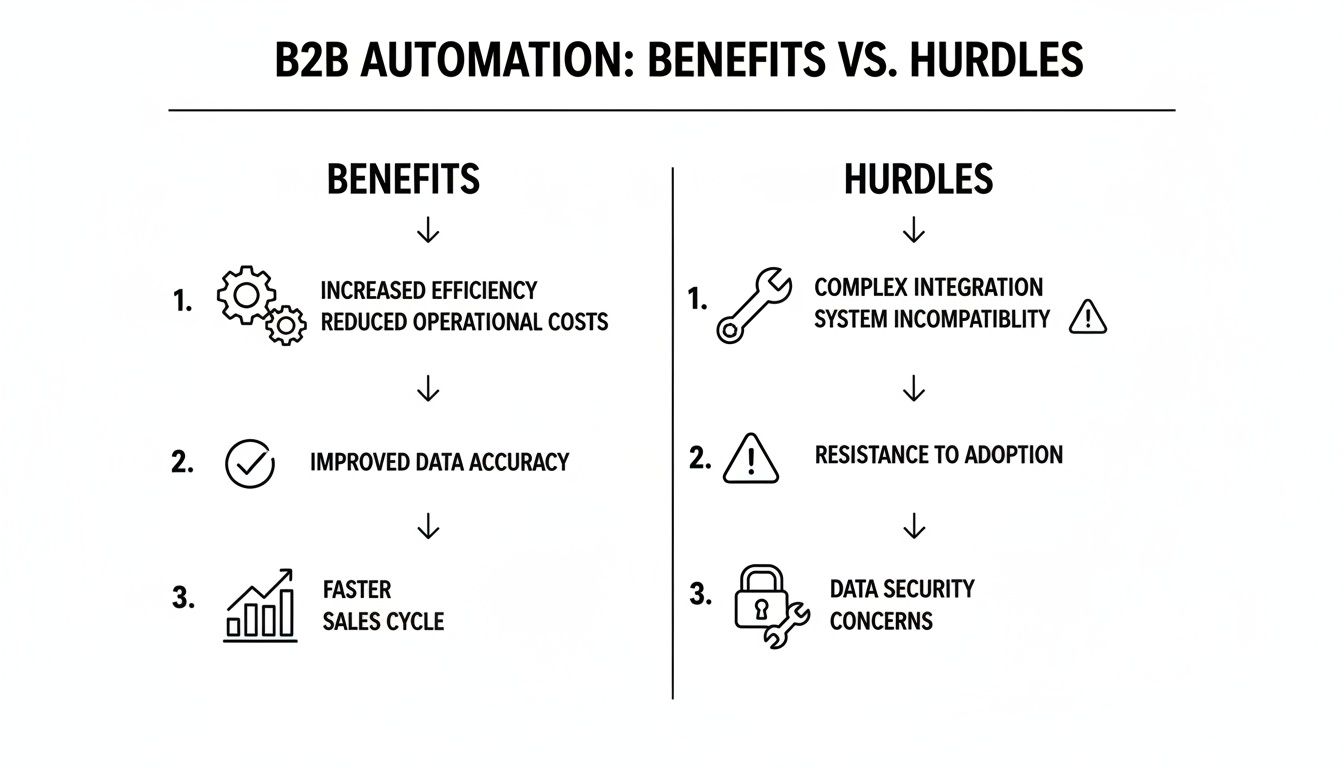
As the visual shows, while the rewards like efficiency and better lead quality are huge, challenges like data accuracy and system integration are very real.
Once your pilot campaign is live, track its performance obsessively against the goals you set back in Step 1. Use the platform’s analytics to see what’s working and what isn’t. This data-driven feedback loop is what turns your initial setup into a powerful engine for continuous improvement and growth.
Putting Your Automation and CRM on the Same Team

Trying to run B2B marketing automation without plugging it into your CRM is like having a powerful engine with no steering wheel. You can generate a ton of noise and activity, but you have no real way to steer it all toward the finish line: closing deals.
Connecting these two systems isn't just a "nice-to-have"—it's the bedrock of any serious B2B marketing strategy. It creates one central, undisputed record for every single customer interaction.
This two-way street of information dismantles the all-too-common wall between marketing and sales. Marketing gets to see the complete journey, from the first ad a person clicked to the last email they opened. Sales gets a rich, detailed history of a lead’s interests before they even make the first call.
When marketing efforts and sales results live in the same house, everybody wins. Handoffs become seamless, conversations get smarter, and you can finally draw a clear line from a marketing campaign to actual revenue.
The Power of a Single Source of Truth
At its core, the goal of integration is to build a complete, 360-degree view of every prospect and customer. Without it, marketing is just guessing what happens after they pass a lead over, and sales is walking into calls with zero context.
A solid integration means data moves between systems automatically and in real time. When a prospect’s lead score jumps because they just attended your webinar, that activity instantly pops up in the CRM for the sales rep to see. That real-time sync is what makes your B2B marketing automation truly powerful.
When your CRM and marketing automation platform are in constant conversation, you eliminate the guesswork. Sales knows which leads to prioritize based on real-time engagement data, and marketing can prove its direct contribution to the sales pipeline.
Mapping Data for a Flawless Handoff
One of the most crucial, hands-on steps in this process is data mapping. It sounds technical, but it’s really just about telling the two systems how to speak the same language by matching up corresponding fields. Think of it as introducing two people and explaining what they have in common.
You'll map the "Email" field in your automation tool to the "Email" field in your CRM—that part's easy. But the real strategy comes in deciding which pieces of marketing intelligence are most valuable for your sales team.
Make sure you sync these key data points:
- Lead Source: How did we first meet them? (e.g., LinkedIn, Organic Search, Trade Show)
- Lead Score: A clear, numerical rating of how sales-ready they are.
- Recent Key Activities: What have they done lately? Visited the pricing page? Requested a demo?
- Company Information: Firmographic data like industry, company size, and revenue.
Carefully mapping these fields ensures every lead arrives with a story. This kind of preparation isn't just for marketing data; you can see how connecting other tools adds value in our guide to CRM and VoIP integration.
Designing Workflows That Actually Help Sales
This is where the integration truly comes to life. You can build automated workflows—simple "if this, then that" rules—that move leads through the funnel without anyone lifting a finger. A well-built workflow ensures a hot lead never goes cold from waiting around.
The absolute most important workflow to build is the lead handoff rule. This is the trigger that decides when a lead is officially "marketing qualified" and ready to be synced to the CRM for a salesperson to contact.
A classic, effective rule is to sync a lead only after their lead score crosses a specific threshold, like 100 points. This single rule stops sales from being overwhelmed with lukewarm leads and gives marketing the space to nurture contacts who just aren't ready yet. It creates a clear, data-driven pact between the two teams, turning potential conflict into collaboration.
To keep your integration on track, use this checklist to manage the key steps.
Marketing Automation and CRM Integration Checklist
Here are the essential steps for making sure your marketing automation platform and CRM work together perfectly from day one.
| Integration Step | Key Consideration | Status (Template) |
|---|---|---|
| Define Goals | What specific problem is this integration solving? (e.g., improve lead quality, shorten sales cycle) | ☐ To-Do / ☐ In Progress / ☐ Complete |
| Choose a Primary System | Which system will be the master record if data conflicts? (Usually the CRM) | ☐ To-Do / ☐ In Progress / ☐ Complete |
| Map Standard Fields | Match basic contact and company fields (Name, Email, Phone, Company Name). | ☐ To-Do / ☐ In Progress / ☐ Complete |
| Map Custom Fields | Identify and map key marketing fields (Lead Source, Lead Score, Recent Activity). | ☐ To-Do / ☐ In Progress / ☐ Complete |
| Establish Sync Rules | When does a record sync? (e.g., when a lead score > 100). | ☐ To-Do / ☐ In Progress / ☐ Complete |
| Configure User Permissions | Who can see and edit synced data in the CRM? | ☐ To-Do / ☐ In Progress / ☐ Complete |
| Build Test Scenarios | Create a test lead and push it through the workflow to verify all data syncs correctly. | ☐ To-Do / ☐ In Progress / ☐ Complete |
| Train the Sales Team | Show sales reps where to find the new marketing data and how to use it in their process. | ☐ To-Do / ☐ In Progress / ☐ Complete |
Following a structured checklist like this prevents critical details from slipping through the cracks and ensures both marketing and sales get exactly what they need from the integration.
Got Questions? We’ve Got Answers.
Jumping into B2B marketing automation is a big step. It’s a serious investment of time and money, so it’s completely normal to have a few questions swirling around. You want to be sure you’re making the right call for your business.
We get it. We’ve heard these same questions from countless B2B teams. Here are some straight-talking answers to clear things up.
What’s This Going to Cost Us?
This is usually the first thing on everyone's mind, and the honest answer is: it depends. There’s no universal price tag. The cost really boils down to a few key things, mainly how many contacts you have and what features you actually need.
Here’s what typically shapes the price:
- Number of Contacts: This is the big one. Most platforms charge based on the size of your database. More contacts usually mean a higher monthly bill.
- Feature Set: Are you just looking for basic email campaigns and simple workflows? Or do you need the whole suite—advanced lead scoring, account-based marketing tools, and sophisticated reporting? The more you need, the more you'll invest.
- Implementation and Onboarding: Some providers charge a one-time fee to get you set up. This can be anything from a few hundred bucks to several thousand dollars for hands-on support.
For a small or mid-sized business, you can expect to pay anywhere from a few hundred dollars a month for a starter plan to a few thousand for a powerhouse platform. The trick is to find a solution that solves today's problems without overpaying for features you won’t touch for another two years.
How Long Until We Actually See a Return?
With B2B marketing automation, you have to play the long game. This isn't like a B2C flash sale where you see results in a few hours. Remember, you're building relationships and guiding businesses through complex buying decisions. That just takes time.
You might see some quick wins in the first few months, but the real, measurable return on investment (ROI) usually starts to show up around the 6 to 12-month mark. That’s when you’ll have enough data to see a real impact on lead quality, conversion rates, and how long it takes to close a deal.
Think of the first few months as your setup phase. You’ll be learning the ropes, building your first campaigns, and getting everything integrated. The magic happens once your nurture sequences have had time to work and your sales team starts getting leads that are genuinely ready to talk.
Do We Need to Hire Someone Just for This?
In the beginning, you definitely need someone to own it. While "automation" is in the name, these platforms don't run themselves. Someone has to be the strategist behind the scenes—building the workflows, creating the content, and analyzing what’s working and what’s not.
For smaller teams, this doesn't have to be a full-time gig. A marketing manager might carve out a specific part of their week to manage the system. But as you get more sophisticated, a dedicated marketing ops person can be a game-changer. The most critical thing is that it's not treated as a side project that gets pushed to the back burner. Accountability is everything.
So, What's the Best B2B Marketing Automation Software?
The “best” software is whichever one fits your business like a glove. The market is full of great tools, but they all have different strengths. What works for a Fortune 500 company might be total overkill for you.
Here’s what to focus on when you’re shopping around:
- Core Features: Does it do the one or two things you absolutely need it to do, and do them well? (Think email nurturing, solid CRM integration, etc.).
- User-Friendliness: Is the platform intuitive? Your team has to actually use it, so a clunky interface is a deal-breaker.
- Integrations: This is non-negotiable. Does it play nicely with your CRM and the other tools you rely on every day?
- Scalability: Can it grow with you? The last thing you want is to have to rip everything out and start over in two years.
Stop looking for the one "best" platform and start looking for the right fit for where you are now. Always, always sign up for free trials and sit through a few demos. You need to get a feel for the software before you commit.