Imagine your sales team had a crystal ball. Not a mythical one, but a tool that could look at all your past deals and customer chats to point out who’s most likely to buy next. That’s pretty much what predictive sales AI does. It’s like giving your team a cheat sheet for hitting their targets.
What Is Predictive Sales AI and Why It Matters Now

At its core, predictive sales AI is a smart system that uses machine learning to sift through your data and find hidden patterns. It looks at everything—past wins, losses, customer interactions, you name it—and uses that information to make educated guesses about the future. The goal isn't to replace your salespeople, but to arm them with insights they could never find on their own.
Every B2B sales team knows the drill: reps waste tons of time on dead-end leads, and leaders are stuck making critical decisions based on shaky revenue forecasts. This is exactly the pain point predictive analytics was built to solve.
Moving Beyond Gut Feelings
For decades, sales has run on experience and intuition. While a seasoned rep's gut feeling is invaluable, it's not always scalable or consistently accurate. Predictive sales AI doesn't dismiss that experience; it complements it with hard data, shifting your team from reacting to problems to getting ahead of them.
Think about it. Instead of treating every new lead the same, the AI can score them based on how likely they are to actually become a customer. This simple change allows your team to focus their best efforts on the leads that matter most.
By focusing on high-potential leads and at-risk deals, sales teams can dramatically improve their efficiency and win rates. It’s about working smarter, not just harder.
The table below breaks down just how different the day-to-day looks when you move from a traditional approach to one powered by predictive AI.
Traditional Sales vs Predictive Sales AI
| Activity | Traditional Sales Approach | Predictive Sales AI Approach |
|---|---|---|
| Lead Prioritization | All new leads are treated equally, or prioritized based on basic firmographics (e.g., company size). | Leads are automatically scored and ranked based on their likelihood to convert. |
| Forecasting | Based on reps' subjective opinions and gut feelings. Often inaccurate. | Based on historical data and win probability scores for each deal in the pipeline. |
| Customer Retention | Reacts to customer complaints or churn after the fact. | Proactively identifies at-risk accounts based on behavior and usage patterns. |
| Sales Strategy | Relies on past experience and broad market assumptions. | Driven by data-backed insights on which customer profiles and deal types are most profitable. |
As you can see, the shift is from a reactive, often manual process to a proactive, automated one that lets your team focus on what they do best: building relationships and closing deals.
The Core Functions
So, what does this technology actually do? Predictive sales AI performs a few critical jobs that tackle some of the biggest headaches in sales. It essentially turns your CRM from a simple record-keeping tool into a strategic advisor.
Here’s what it typically handles:
- Predictive Lead Scoring: It tells your reps which prospects are hot and which are not, so they can focus their energy where it will have the biggest impact.
- Opportunity Win Probability: It looks at the details of an open deal and calculates the odds of it closing, making your pipeline forecasts much more reliable.
- Churn Prediction: It acts like an early warning system, flagging existing customers who might be thinking of leaving so you can step in and save the relationship.
- Sales Forecasting: It creates surprisingly accurate revenue projections by analyzing your current pipeline against historical performance data.
This isn't just a futuristic concept anymore. According to a report from Grand View Research, the global AI in sales market was estimated at USD 24.64 billion in 2024. As other market trend reports show, this technology is quickly becoming standard practice for high-performing sales organizations.
How Predictive AI Drives Measurable Sales Growth

It's one thing to understand what predictive sales AI is, but its real power is in what it does for your bottom line. We're not just talking about fancy charts; this is about turning your raw data into a clear roadmap for growing revenue. It helps your team answer the two most important questions in sales: “Who should I talk to next?” and “What’s the best way to move this deal forward?”
When your team can answer those questions with data-backed confidence, everything changes. The focus shifts from a spray-and-pray approach to smart, proactive engagement. Every call, email, and meeting has a purpose, driving real business results.
Instantly Prioritize Your Best Leads
One of the first things you'll notice is the end of guesswork in lead management. Think about the classic sales approach: a flood of leads comes in, and reps start dialing, hoping to strike gold. It's like searching for a needle in a haystack. Predictive AI flips that entire model on its head.
The system digs into your historical data—every win, loss, and customer conversation—to build a crystal-clear picture of your ideal customer profile. It then automatically scores every new lead based on how well they fit that successful mold.
This means your reps log in each morning to a perfectly prioritized to-do list. The hottest leads are right at the top, ready for immediate attention, while cooler leads can be put into an automated nurturing sequence. It’s a massive boost for both efficiency and morale because reps are finally spending their time on conversations that are far more likely to go somewhere.
With AI-driven prioritization, sales reps can focus their efforts on the top 20% of leads that are most likely to close, instead of spreading their time evenly across all opportunities. This focus is a game-changer for productivity.
Sharpen Forecasting and Pipeline Management
Shaky sales forecasts are a constant headache for sales leaders. When your revenue projections rely on a rep's gut feeling, it’s almost impossible to plan with any certainty. Predictive AI replaces that guesswork with cold, hard math.
For every single deal in your pipeline, the AI calculates a win probability score. It looks at factors like the deal stage, how engaged the prospect is, and how similar it is to deals you've won in the past. This gives leadership a clear, data-driven view of the pipeline, making revenue forecasts far more reliable. You can dive deeper into this in our ultimate guide to B2B pipeline management.
These insights also help you manage the pipeline proactively. A sales manager can spot a deal where the win probability has suddenly dropped, letting them jump in with coaching and support before it stalls out completely.
Guide Reps with Next-Best-Action Suggestions
Think of predictive AI as a co-pilot for your sales team. It provides real-time guidance on the exact next step needed to move a deal closer to the finish line. By analyzing thousands of past sales cycles, the system knows what works and when.
For instance, the AI might suggest:
- Sending a specific case study to a prospect in the manufacturing industry because it worked well on similar deals.
- Following up with a phone call because email engagement from this contact has tapered off.
- Bringing in a technical expert now that the deal has reached the demo stage.
These "next-best-action" prompts take the ambiguity out of selling. They help reps build momentum, shorten sales cycles, and stick to the playbook that’s proven to win. Early adopters have seen incredible results, with some teams boosting win rates by around 30%. On top of that, AI automation can free up reps' time, leading to a 15% jump in productivity. This kind of guidance is how you turn your average performers into consistent closers.
Weaving Predictive AI Into Your CRM Workflow
Predictive sales AI isn't some standalone app you have to force your team to use. Its real magic is how it plugs right into the one tool your sales team already lives and breathes in every day: your CRM. This tight integration is what turns interesting data points into actions that actually close deals.
Think of your CRM as the central hub for your entire sales operation, holding all the crucial information about your customers and deals. The predictive AI engine connects directly to this hub, acting like a super-smart brain that constantly analyzes all the data flowing through it. The whole point is to enhance your existing workflow, not blow it up and start over.
How Does The Integration Actually Work?
It’s all about creating a continuous, intelligent loop between the AI and your CRM. First, the predictive sales AI pulls in all your historical CRM data. We're talking everything—every closed-won and closed-lost deal, every lead source, every email opened, and every call logged. It combs through years of this information to find the hidden patterns and common threads that define a successful sale for your business.
Once it learns what a winning deal looks like, it sends its insights right back into your CRM. This gives your existing data a massive upgrade with powerful new information:
- Predictive Lead Scores: Each new lead can get a simple score (like A, B, C or 1-100) that shows how likely they are to convert.
- Opportunity Win Probabilities: Open deals are updated with a real-time percentage chance of closing, helping reps prioritize their time.
- Next-Best-Action Prompts: Reps will see specific, data-backed suggestions appear right on the deal record, telling them what to do next.
This means your sales reps don’t have to jump between screens or learn a new piece of software. The intelligence they need shows up exactly where they’re already working, which makes getting them on board a whole lot easier.
Why Clean Data Is Non-Negotiable
For any of this to work, the AI needs a solid foundation of clean, trustworthy data. A predictive model is only as smart as the information it learns from. If your CRM is a mess of duplicate records, incomplete fields, and inconsistent entries, the AI's predictions will be just as messy. It’s the classic "garbage in, garbage out" problem.
Think of your CRM data as the fuel for your predictive AI engine. High-quality, clean fuel leads to peak performance. Dirty fuel will just cause the engine to sputter and stall.
Before you even think about implementing predictive sales AI, you absolutely have to do a data health check. This means hunting down and merging duplicate contacts, standardizing fields (like job titles and industries), and making sure every deal outcome is logged correctly. Building good data habits is the single most important thing you can do to get a real return on your AI investment.
If you need a better picture of what a well-organized system looks like, it helps to explore some effective CRM database examples to guide your cleanup.
By tidying up your CRM and focusing on data quality, you create the perfect environment for predictive AI to do its best work. This is how you transform your CRM from a simple record-keeper into an intelligent guide that actively helps your team close more deals, faster.
Your Five-Step Predictive AI Implementation Plan
Bringing new tech into your sales process can feel like a huge project, but you can make it completely manageable by breaking it down. This five-step roadmap is your playbook for getting a predictive sales AI solution up and running without the usual headaches.
Following these stages helps you sidestep common mistakes and start seeing a return on your investment much faster. Think of it like building a custom race car: you have to know what you want it to do, gather the best parts, find the right mechanic, take it for a test drive, and then finally get it on the track.
Step 1: Define Your Core Objectives
Before you even start looking at vendors, you need to nail down exactly what you want this AI to do. A vague goal like "improve sales" won't cut it. You need to get specific and tie your goals to real numbers you can track.
So, what does a clear objective look like in practice?
- Increase win rates on deals over $10,000 by 15% within six months.
- Reduce sales cycle length for mid-market accounts by 20% in the next quarter.
- Improve forecast accuracy to within a 5% margin of error each month.
Setting precise targets like these gives you a clear benchmark for success. It also makes it much easier to pick a tool that’s built to solve your most important challenges.
Step 2: Assess Your Data Readiness
A predictive AI is only as good as the data you feed it. Your CRM is the fuel tank, and if the fuel is contaminated, the engine is going to stall. This is why you have to do a serious data health check before you go any further.
Start by asking some tough questions:
- Is our CRM data clean and consistent, or is it a mess of duplicates and half-filled records?
- Do we track both won and lost deals with clear reasons for the outcome?
- Do we have at least one to two years of historical sales data for the AI to analyze?
If your data isn't ready, your first job is a cleanup project. This foundational work is an absolute must. Without it, you’ll never get the accurate, reliable predictions you're paying for from any predictive sales AI platform.
The whole process is pretty straightforward: good data goes in, the AI does its analysis, and valuable insights come out.
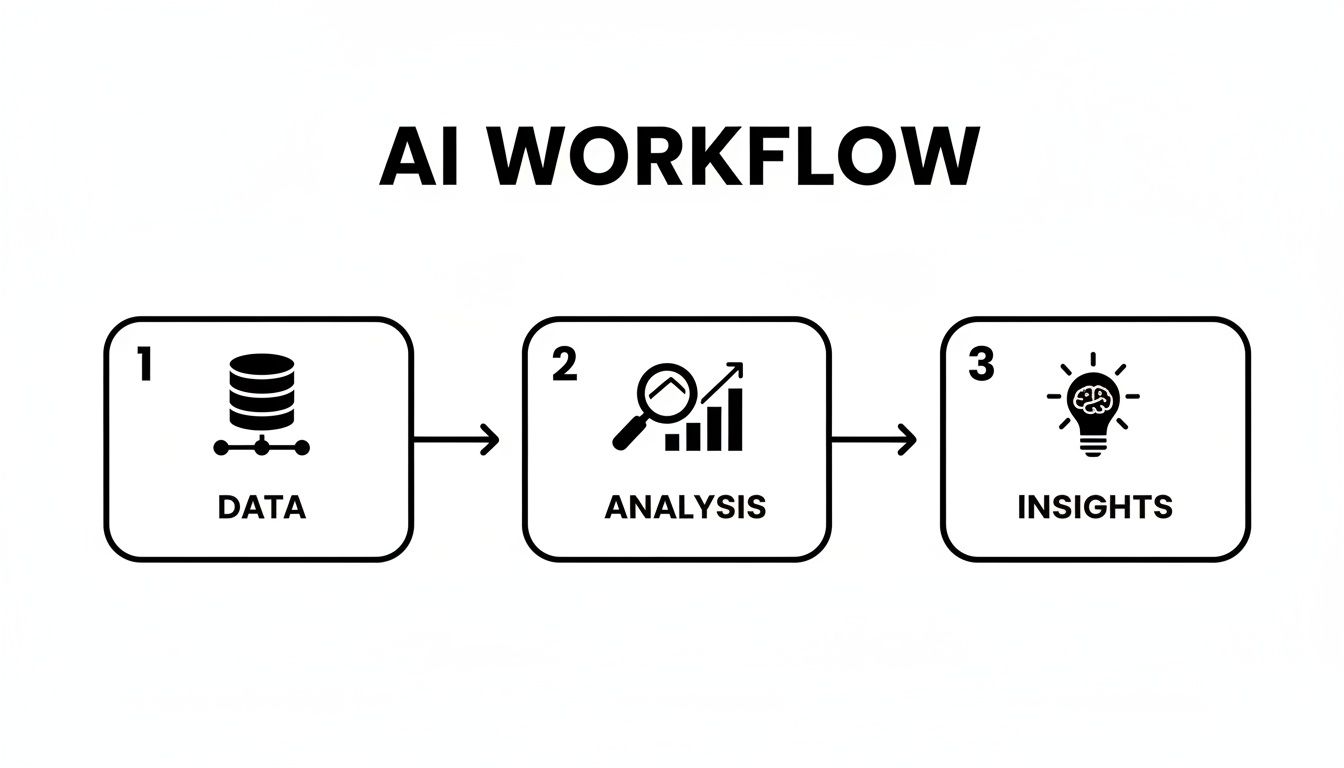
This simple flow drives home the point: the quality of what you put in directly dictates the value of what you get out.
Step 3: Choose the Right AI Partner
Not all predictive AI tools are the same. When you’re evaluating different options, you want a partner who gets the unique grind of B2B sales. The right platform has to integrate smoothly with the tools you already use, especially your CRM.
Choosing a vendor is more than just buying software; it’s a partnership. Look for a provider that offers great onboarding, ongoing training, and a clear plan for how their tech will help you crush your specific goals.
A solid CRM is the heart of this entire operation. If your current system is clunky or holding you back, it might be time to look into customized CRM software that’s built to handle advanced AI integrations.
Step 4: Launch a Pilot Program
Instead of trying to flip a switch for the whole company at once—which can be chaotic—start small. Pick a handful of your most tech-savvy and coachable sales reps and have them test-drive the platform for 30 to 60 days.
This pilot program approach lets you prove the tool's value on a smaller, more manageable scale.
A successful pilot helps you:
- Get honest, real-world feedback and iron out any kinks in the workflow.
- Build a powerful internal case study backed by real numbers.
- Create a team of internal champions who can help get everyone else on board later.
This controlled test keeps risk low and builds momentum for a wider launch, making the full rollout a much smoother ride.
Step 5: Scale with Training and Support
Once your pilot is a proven success, it’s time to roll the solution out to your entire sales team. The key here isn't just the tech—it's the people. Your team needs to understand how the tool works and, more importantly, why it makes their life easier.
Put together a solid training plan that focuses on how the AI insights will help them close more deals and hit their quotas. Offer ongoing support, run regular Q&A sessions, and make sure to celebrate early wins to keep everyone motivated. Great training is what separates a tool that gets installed from a tool that actually gets used.
How to Actually Measure the ROI of Your Predictive Sales AI
Putting a predictive sales AI platform in place is a big step, and you need to know if that investment is actually making a difference. Proving its worth means going beyond a simple "we're closing more deals." You need to track specific metrics that draw a straight line from the AI's insights to real-world improvements in your sales numbers.
This isn't just about justifying the cost to your boss. It’s about figuring out what’s working so you can do more of it. By keeping an eye on the right key performance indicators (KPIs), you can build a rock-solid case showing exactly how this tech is fueling growth and making your whole operation more efficient.
The Key Metrics That Tell the Real Story
To get a clear picture of your return, you have to look past the surface-level vanity metrics. Instead, focus on the KPIs that predictive AI is built to move. These numbers will give you a clean "before and after" snapshot of your sales team's health.
Here are the essential KPIs you should be watching:
- Lead Conversion Rate: What percentage of your leads are turning into legitimate opportunities? If this number is climbing, it's a great sign the AI's lead scoring is pointing your team toward the right prospects.
- Sales Cycle Length: How long does it take to get a deal from that first "hello" to a signed contract? Predictive AI can shrink this timeline by suggesting the right next step, helping reps keep deals moving forward instead of letting them stall out.
- Average Deal Size: The AI is great at spotting chances to up-sell or cross-sell, and it can steer reps toward bigger, more valuable accounts. The result? More revenue from every single win.
- Win Rate: A classic for a reason. What percentage of your opportunities do you actually close? When this metric goes up, it shows the AI's win probability scores are helping your team focus their energy on the right deals and rescue those that might be slipping away.
Tracking these gives you the cold, hard data to prove that your predictive sales AI isn't just another shiny tool—it's a fundamental part of your revenue engine.
When you zero in on these core KPIs, the conversation changes. It’s no longer, "How much does this cost?" Instead, it becomes, "Look at the incredible value this is creating." The data will tell that story for you.
Finally, a Forecast You Can Trust
One of the first things you'll notice is how much more reliable your revenue forecasts become. The guesswork and gut feelings that sales leaders so often rely on get replaced by data-backed probability scores for every deal in the pipeline. This gives everyone a much clearer window into what's coming.
This jump in forecast accuracy is a huge ROI metric all on its own. Predictive models can slash forecast errors, with many companies seeing reductions in the 10–25% range. That precision allows for smarter financial planning, better resource allocation, and a more stable business overall. You can read more about the growth of sales intelligence technology here.
Don't Forget About Long-Term Customer Value
The AI's job isn't done once a deal is signed. It also plays a massive role in getting the most value out of your customer relationships over the long haul. By keeping an eye on how customers are using your product and engaging with your team, the system can flag accounts that are at risk of churning, giving you a chance to step in before it's too late.
This brings us to two final, crucial KPIs for measuring long-term ROI:
- Customer Churn Rate: If the percentage of customers leaving each month or quarter is going down, that's a direct result of the AI helping you hold onto your hard-won business.
- Customer Lifetime Value (CLV): By cutting down on churn and spotting opportunities for expansion, the AI helps you earn more revenue from every customer throughout your entire relationship with them.
When you add up the immediate wins in sales efficiency with the long-term gains in customer retention, the financial argument for predictive sales AI becomes impossible to ignore.
Common Questions About Predictive Sales AI
Diving into any new technology brings up good questions. When you're talking about something with the potential to reshape your sales process, like predictive sales AI, you absolutely need clear answers before you jump in. This section tackles the real-world concerns we hear from B2B leaders all the time.
We'll cut through the hype and get straight to the practical worries that pop up when a business thinks about adding this kind of intelligence to its sales stack.
Is Predictive Sales AI Only for Large Enterprises?
Not anymore. It's true that the big players were the first ones to the party, but that was years ago. The game has completely changed. Today, you'll find plenty of AI solutions built specifically with the budget and agility of a small or medium-sized business in mind.
Modern tools are usually cloud-based, which means you get flexible pricing and can get up and running quickly. The trick is finding a partner who gets the SME world—one who can deliver real results even if you don't have a massive vault of historical data to feed the system.
The right predictive sales AI for an SME is all about quick wins and ease of use. It should plug right into your B2B CRM and start showing its value without getting bogged down in a long, complicated project.
Will AI Replace My Sales Team?
This is probably the number one fear we hear, but it comes from a misunderstanding of what this technology actually does. The goal of predictive AI isn't to replace your salespeople. It's to augment them—to make them smarter, faster, and more effective at their jobs.
Think of it like giving every rep on your team a super-powered assistant. The AI does the heavy lifting and grunt work, like sifting through thousands of potential leads to find the handful that are actually ready to talk. This frees up your team to focus on the human stuff that no machine can do:
- Building real, lasting relationships with customers.
- Understanding a client's complex business challenges.
- Navigating the subtle art of negotiation to close a great deal.
In the end, it helps your team spend less time guessing and more time selling.
How Much Historical Data Do We Really Need?
You probably need less than you think. You don't need a perfectly curated, ten-year-old database to get going. Most modern predictive models can start producing solid insights with just one to two years of reasonably clean CRM data.
What’s far more important than the sheer amount of data is its quality and consistency. The system needs a clear history of your wins and your losses, along with the key details and sales activities tied to each. Most vendors will even do a data readiness check to see if your foundation is strong enough to build on.
What Is a Realistic Implementation Timeline?
Getting started with predictive sales AI is a lot faster than you might imagine. For a pilot program—where you test the tool with a small group to prove it works for your team—you can often be up and running in just a few weeks.
A full rollout to the entire sales team usually takes somewhere between two and three months. Of course, the exact timeline depends on things like how clean your CRM data is and how complex your sales process is, but the days of year-long IT marathons are thankfully behind us.